Why Whitepaper Leads Go Silent After Download and How to Fix It

Quick Answer
Whitepaper leads go silent because most follow-up sequences are built around the download event, not the buyer. The download tells you someone was interested at one moment. It tells you nothing about their role, their timeline, their authority to buy, or whether they were comparing three other vendors when they found your content. Fixing this requires a follow-up sequence timed to engagement behaviour rather than the download date, a qualification layer that runs before leads reach sales, and a sales handoff that gives reps the context they need to start a real conversation rather than a cold introduction.
The Download Is Not the Lead
Every whitepaper campaign produces the same post-mortem conversation. The downloads came in. The form was completed. The MQL count looked respectable in the weekly report. Then sales started working the list, and the replies never came.
The mistake most teams make is treating the download as evidence of buying intent. It is not. A download is a signal that someone found your content relevant enough to hand over an email address. That is all it confirms. Whether that person is a decision-maker, a researcher, a competitor, a student, or someone who downloaded the PDF and immediately moved on to something else the download event tells you nothing about any of that.
This is not a content problem. It is a process problem. And it starts well before sales sends the first email.
Five Reasons Whitepaper Leads Go Cold
1. The follow-up arrives too late
Most B2B marketing automation systems are configured to send a follow-up email 24 to 48 hours after a download. By that point, the buyer’s attention has moved on. They are in three other conversations, have opened four other pieces of content, and your whitepaper is somewhere in a downloads folder they will not revisit.
The window for meaningful engagement after a content download is narrower than most teams assume. Research consistently shows that response rates to follow-up drop by more than half after the first hour. Not the first day the first hour. For a whitepaper download that happens on a Tuesday afternoon, the automated email arriving Wednesday morning is already working against a significant attention deficit.
The fix is not to automate faster for the sake of speed. It is to design a sequence where the first touchpoint is immediate, low-friction, and does not ask for anything. A simple confirmation email that delivers value a one-page summary, a relevant case study, a link to a related resource keeps the buyer engaged while the lead is still warm.
2. The first email asks for a meeting before it earns one
The most common follow-up email template in B2B marketing starts with a variation of this: “I noticed you downloaded our whitepaper I’d love to set up 15 minutes to discuss how we can help.”
From the buyer’s perspective, this reads as: you gave us your email address and now we want to sell you something. The download was not a meeting request. The buyer was educating themselves, not raising their hand to speak to a salesperson.
Leads that go silent after this type of outreach are not bad leads. They are leads that received the wrong message at the wrong stage. The first follow-up after a whitepaper download should extend the value of the content, not immediately pivot to a sales conversation. Add context, add a related insight, ask a question that requires a genuine answer rather than a yes or no. Earn the conversation before requesting it.
3. The lead was never qualified in the first place
This is the version of the problem that most teams avoid talking about because it raises uncomfortable questions about campaign targeting. If the whitepaper was distributed through a broad content syndication network without firmographic filters industry, company size, seniority level, job function the lead list includes a significant proportion of contacts who were never ICP-matched.
You can write the perfect follow-up sequence, time it correctly, and personalize every email and still get no response from contacts who were not the right accounts to begin with. Silence in this case is not a follow-up problem. It is a targeting problem that the follow-up sequence cannot fix.
The Real Problem |
The most expensive version of this mistake is when a sales team spends two to three weeks working a lead list before anyone checks the job titles and company sizes against the ICP. By the time the disconnect is identified, the cost is not just the campaign spend it is the SDR time, the opportunity cost of not working qualified accounts, and the quota attainment damage from a quarter with low pipeline. |
4. Sales got the lead without enough context to start a real conversation
Imagine receiving a lead that shows name, company, email, job title, date of download. That is the standard handoff most sales teams get. From that information, an SDR knows what the person is called and where they work. They do not know what part of the whitepaper resonated, whether the contact has visited the website since downloading, what other content they have engaged with, or where they are in their buying process.
The result is a first outreach that opens with something generic a reference to the whitepaper download, a description of what the company does, a request for time. The buyer’s inbox receives dozens of every week. There is no reason to respond to this one.
A sales handoff that converts requires more than a name and email. It requires behavioural context: what the lead did after downloading, how long they spent on the content, whether they returned to the site, whether they viewed pricing or service pages. That context is the difference between a warm introduction and a cold call wearing a marketing label.
5. There is no structured nurture between the download and the sales outreach
Most whitepaper follow-up processes have two steps: automated email after download, then sales contact. There is nothing in between. For buyers who are in early research mode which describes the majority of whitepaper downloaders that gap is where interest fades.
A buyer who downloads a whitepaper on Tuesday and receives a sales call on Thursday has had no additional touchpoints to reinforce why your solution matters. They have not seen a case study that mirrors their situation, a short explainer on a specific problem, or a piece of content that addresses the next logical question after reading your whitepaper.
The B2B buying process for complex, high-value solutions do not move in two steps. Treating the nurture phase as optional is the main reason pipeline from whitepaper campaigns consistently underperforms against its potential.
The Follow-Up Sequence That Actually Works
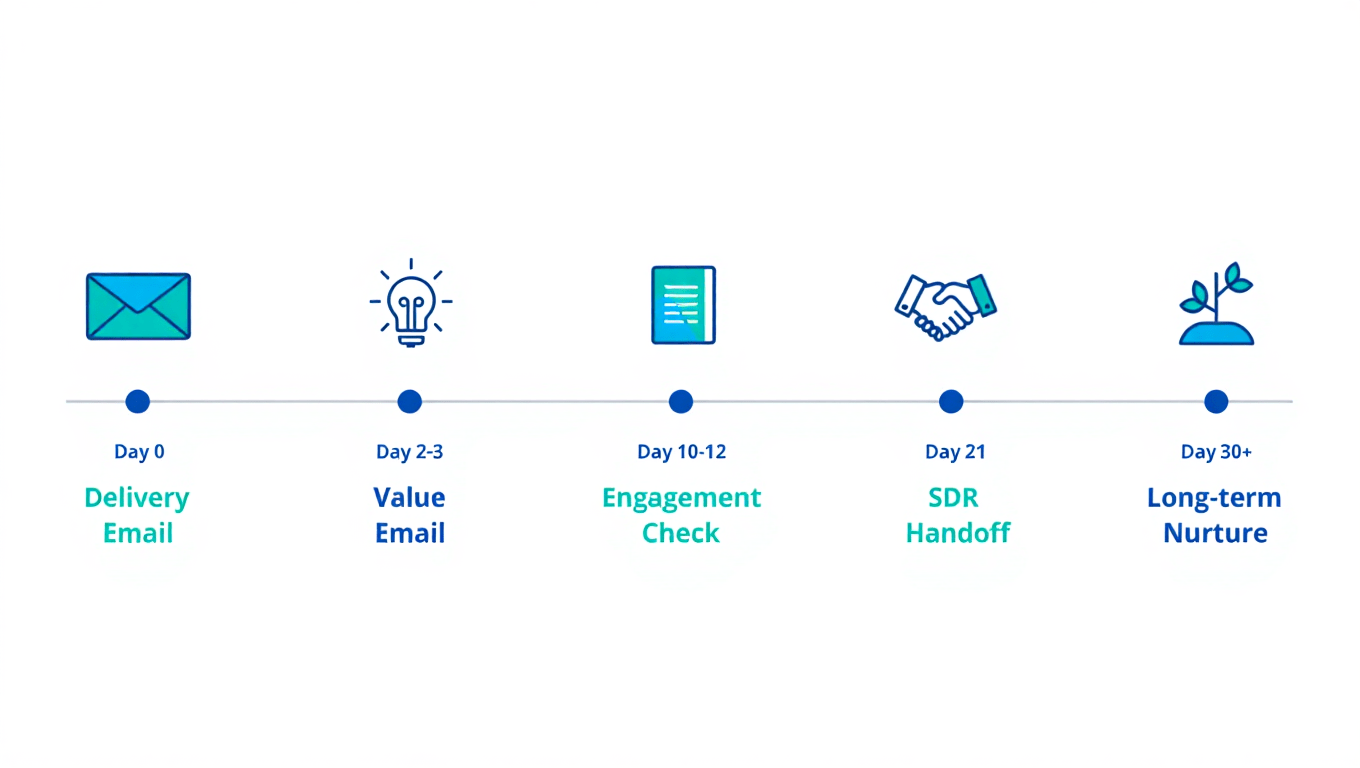
The sequence below is built around one principle: move at the buyer’s pace, not the marketing calendar. Each touchpoint earns the next one by delivering value rather than requesting a commitment.
Lead Follow-Up Timeline
| Day | Touchpoint | What It Does | What Not to Do |
|---|---|---|---|
| Day 0–1 | Automated delivery email | Confirms the download, delivers a one-page summary or companion resource, sets expectations for follow-up | Do not include a meeting link or a sales ask |
| Day 2–3 | Personalised value email | References a specific section of the whitepaper, adds one related insight or stat the paper did not cover, asks a single open question | Do not mention your product or service by name yet |
| Day 5–7 | Content touchpoint | Sends a short case study or data point directly relevant to the buyer's industry or company size | Do not resend the whitepaper or reference the original download again |
| Day 10–12 | Soft engagement check | Asks whether the whitepaper raised any questions worth discussing; frames a conversation as exploratory, not a sales pitch | Do not use “just checking in” or “circling back” |
| Day 18–21 | SDR handoff (if engaged) | SDR references the full engagement history — downloads, email opens, site visits — and opens with a specific question based on that context | Do not hand off without providing the SDR the full engagement record |
| Day 30+ | Long-term nurture | Moves non-responsive leads into a lower-frequency track with relevant content; does not abandon them or mark them as lost | Do not send the same nurture content that failed to generate a response at a higher frequency |
The key shift in this sequence is that sales does not enter the conversation until there is something concrete to reference. By Day 18, a lead that has opened three emails, returned to the website, and read a case study is a fundamentally different conversation than a lead that has had no engagement beyond the original download. The SDR is not starting cold they are extending a conversation that has already been happening.
Using Engagement Signals to Prioritise Your List
Not every whitepaper lead deserves the same follow-up investment on the same timeline. The engagement signals between the download and the first sales touchpoint tell you which leads to prioritise and which to keep in a lower-touch nurture track.
The signals worth tracking fall into two categories: content engagement and site behaviour.
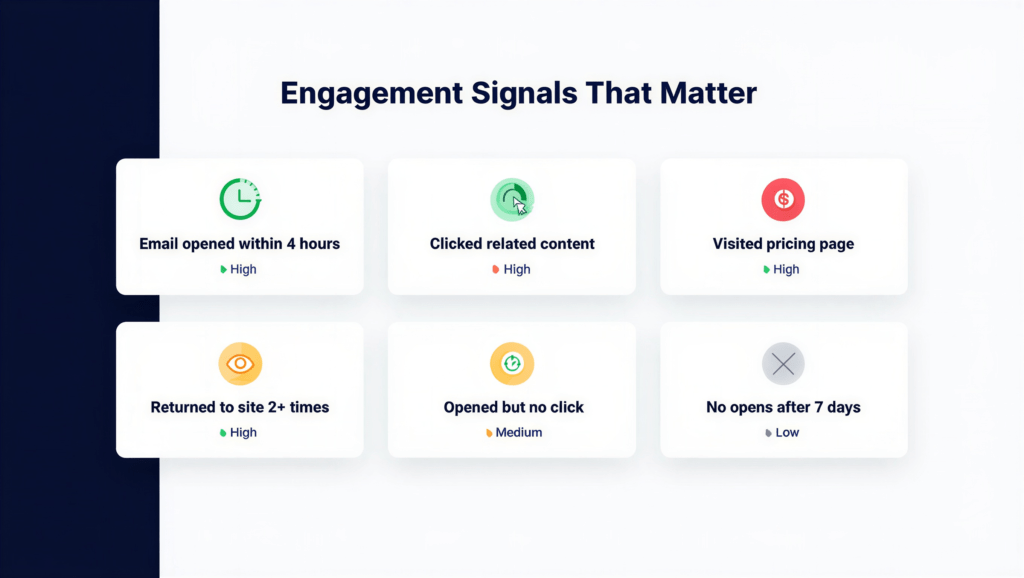
Lead Behaviour Signals
| Signal | What It Tells You | Priority Action |
|---|---|---|
| Opened follow-up email within 4 hours | Still actively in research mode | Move to high-priority track, advance sequence timeline |
| Clicked through to related content | Exploring beyond the whitepaper topic | Send targeted content that addresses the next logical question |
| Visited pricing or services page | Moved from awareness to evaluation | Fast-track to SDR — this lead is further down the funnel than most |
| Returned to site 2+ times after download | Consistent intent signal, not a one-time browser | Prioritise personal outreach and reference specific pages visited |
| Opened email but did not click | Aware of your brand but not yet convinced | Test a different value proposition in the next touchpoint |
| No email opens after 7 days | Low engagement or wrong contact | Move to long-term nurture and recheck ICP qualification |
Lead scoring built on these signals produces a prioritised list that tells your SDR team where to spend their time. A lead with three high-priority signals is worth ten cold calls to leads with none. This is exactly the principle behind a structured lead nurturing and scoring process and it is what separates campaigns that generate pipeline from campaigns that generate contact lists.
What Sales Actually Needs Before Making the First Call
The most common complaint from sales teams about marketing-generated whitepaper leads is not that the contacts are unresponsive. It is that the handoff gives them nothing to work with. A name and email address are not a sales-ready lead it is a starting point for research that the SDR now has to do themselves, without the context that marketing had all along.
Before any whitepaper lead reaches sales, the handoff record should contain:
- The specific whitepaper downloaded and the date
- All subsequent content the lead engaged with and the dates of engagement
- Email open and click history with timestamps
- Pages visited on the company website after the download, including time spent on each
- ICP match confirmation industry, company size, seniority, job function checked against the defined ICP
- A qualification note that answers: what problem is this person likely trying to solve based on their engagement pattern?
That last item the qualification note is the one most teams skip because it requires someone to look at the engagement record and make an inference. But it is also the one that makes the biggest difference in the first call. An SDR who opens with “I noticed you spent time on our case study about mid-market SaaS onboarding after reading the whitepaper is that an area you are actively looking at?” is starting from a different position than one who opens with “I wanted to follow up on the whitepaper you downloaded last week.”
The first question shows the buyer that someone paid attention. The second one confirms that no one did.
How to Tell if the Problem Is Targeting, Not Follow-Up
Before investing time in rebuilding a follow-up sequence, it is worth checking whether the silence problem is a targeting problem wearing a follow-up mask. There is a quick way to test this.
Pull the last 100 whitepaper leads from a recent campaign. Check the following:
- What percentage match your defined ICP by industry and company size?
- What percentage hold a title that could reasonably influence or own the buying decision?
- What percentage are from companies with a realistic budget for your solution, based on their revenue or headcount?
If fewer than 40% of the list passes all three checks, the silence is primarily a targeting problem. You can optimise the follow-up sequence all you want, but outreach to contacts who were never qualified will continue to produce the same result.
The fix at this stage is not the follow-up process it is the whitepaper placement and promotion strategy. Whitepaper distribution that runs without firmographic filters, without seniority targeting, and without ICP verification at the point of download generates volume that looks healthy in a report and produces nothing in a pipeline review.
This is the situation the whitepaper distribution guide addresses in detail specifically the difference between a campaign built for download volume and one built for qualified pipeline. If your last campaign failed the targeting test above, that is the right starting point before rebuilding any follow-up process.
The Metrics That Tell You Whether the Fix Is Working
Once a new follow-up sequence is in place, there are four numbers worth tracking. Download volume is not one of them.
Campaign Performance Metrics
| Metric | What It Measures | Target Benchmark |
|---|---|---|
| Email open rate by sequence day | Whether the subject line and send timing are working | Day 1: 35%+ | Day 5: 20%+ | Day 10: 15%+ |
| Click-to-open rate (CTOR) | Whether the content inside each email earns engagement | 15–25% CTOR across the sequence |
| MQL to SQL conversion rate | Whether marketing leads are converting to sales-qualified opportunities | Above 20% for a well-targeted campaign |
| Time from download to first sales conversation | Whether the sequence is moving leads through at the right pace | Target 10–18 days for high-engagement leads |
These four numbers together tell you where the sequence is working and where it is breaking down. Low open rates on Day 1 suggest a subject line or send-timing problem. Strong opens but weak CTOR suggest the email content is not delivering enough value to earn a click. Good CTOR but poor MQL-to-SQL conversion suggests the SDR handoff or qualification process needs attention.
Check these numbers monthly, not quarterly. A whitepaper follow-up sequence that is underperforming in February and reviewed in April has wasted a full quarter of pipeline potential.
Key Takeaways
- A whitepaper download is a signal of interest, not a signal of intent. Treating it as a sales-ready event is the primary reason leads go cold.
- The first follow-up email almost always arrives too late and asks for too much. Speed matters, but the first touchpoint should deliver value, not request a meeting.
- If fewer than 40% of your whitepaper leads pass a basic ICP check, the silence problem is a targeting problem that a better follow-up sequence cannot fix.
- Engagement signals between the download and the first sales call site behaviour, email opens, content clicks are what separate leads worth prioritising from those that belong in a long-term nurture track.
- Sales handoffs that include a full engagement history and a qualification note convert at a higher rate than handoffs that deliver only a name, company, and email address.
- Track MQL-to-SQL conversion rate and time-to-first conversation monthly. These two numbers tell you whether the sequence is working far better than download counts or email open rates alone.
Frequently Asked Questions
There are five main reasons: the follow-up arrives too late, the first email requests a meeting before earning one, the lead was never ICP-qualified to begin with, sales received the lead without enough context to personalise outreach, or there was no nurture sequence between the download and the sales call. In most underperforming campaigns, at least two of these five are present simultaneously.
The first touchpoint should arrive within one to two hours of the download, not the next day. This is not a sales call it is a value delivery email that confirms the download and adds a related resource. The actual sales conversation should not begin until Day 10 to 18, and only for leads who have shown consistent engagement with the nurture sequence in the intervening period.
A well-targeted whitepaper campaign with a structured nurture sequence and proper ICP filtering should convert above 20% of MQLs to SQLs. Campaigns without firmographic filters or with generic follow-up sequences typically convert between 5% and 10%. The gap between these two numbers represents the pipeline value of getting the process right.
Qualification runs on two tracks simultaneously. The first is firmographic confirming that the contact’s company matches your ICP by industry, size, and revenue before the lead is scored as an MQL. The second is behavioural tracking post-download engagement to determine whether the contact is actively researching or was a one-time browser. Both tracks need to pass before a lead should be handed to sales.
At minimum: the whitepaper downloaded, the date of download, all subsequent content engagement, email open and click history, website pages visited after download, ICP match confirmation across industry, company size, and seniority, and a qualification note that summarises what the engagement pattern suggests about the buyer’s current problem or priority. Handoffs that include this context produce noticeably different first-call outcomes compared to handoffs that deliver only contact details.
Any lead that shows no email engagement after seven days and no site activity after the initial download should move to a lower-frequency nurture track rather than receive additional high-touch outreach. Continuing to send high-frequency emails to unresponsive contacts increases unsubscribe rates and damages domain reputation. Long-term nurture at monthly intervals keeps the brand present without burning the contact and occasionally re-activates leads when their circumstances change.