Whitepaper Syndication vs Content Syndication: Which Gets You Better B2B Leads?

Both promise pipeline. But they work in completely different ways – and mixing them up is one of the most expensive mistakes B2B marketers make
Every B2B marketing team eventually hits the same wall: you’re producing good content, but the leads aren’t converting the way they should. So you start asking questions. Are we targeting the right people? Is our content resonating? Are we using the right distribution channel?
Two channels come up over and over – content syndication and whitepaper syndication. On the surface, they sound similar. They both involve putting your content in front of new audiences through third-party networks. But they’re built for completely different jobs.
If you’re running them the same way, or using them interchangeably, you’re almost certainly leaving quality leads on the table.
Let’s break down what each actually does, where each one wins, and how to figure out which one belongs in your next campaign.
First, Let’s Get Clear on What Each One Is
The terminology gets muddy fast, especially since vendors often use both terms loosely. Here’s how to think about them cleanly.
Content Syndication
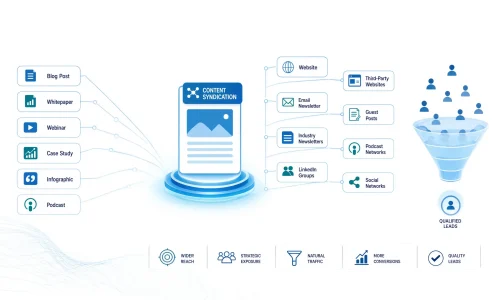
Content syndication is about reach. You distribute blog posts, articles, infographics, videos, and other mid-funnel assets across a network of publisher sites, media outlets, and industry platforms. The goal is to get your brand in front of people who haven’t heard of you yet – and bring them into your funnel.
Think of it like renting billboard space in markets where your ideal buyers already spend time. Your content shows up natively, they engage with it, and (when done right) they end up on your radar as potential prospects.
Content syndication services typically work on a CPL (cost per lead) or CPM model, and they handle the distribution mechanics so your team doesn’t have to manage dozens of publisher relationships.
Whitepaper Syndication
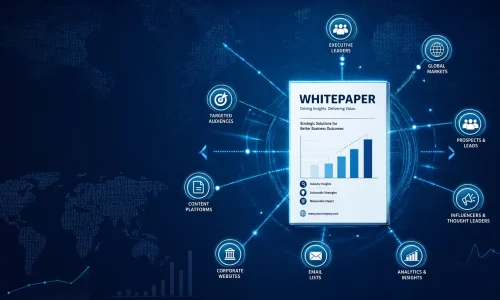
Whitepaper syndication is about intent. A prospect actively requests a piece of gated content – usually a detailed research report, technical guide, or industry analysis – and in exchange, provides their contact details. This is what demand gen professionals call a “content download lead,” and it’s a very different signal from someone who passively read your blog post.
The person downloaded your whitepaper because they’re actively researching something. That’s not casual curiosity. That’s buying-cycle behavior.
Whitepaper placement and promotion puts your long-form assets in front of these actively-researching buyers at the exact moment they’re looking for answers – often through content discovery platforms, intent networks, and B2B publisher audiences.
“Content syndication fills your funnel. Whitepaper syndication finds the people already walking toward a purchase decision.”
The Lead Quality Problem Nobody Talks About
Here’s the thing that rarely gets said directly: volume and quality are in constant tension in B2B lead gen.
You can generate hundreds of leads a month through broad content syndication. Some will convert. Most won’t – not because the channel is broken, but because you’re catching people at very different stages of awareness and intent.
Whitepaper downloads sit much closer to the research phase of the buying cycle. The person who fills out a form to get your “State of Cloud Security 2025” report isn’t just browsing – they’re building a business case, evaluating vendors, or trying to convince an internal stakeholder. That context changes everything for your sales team.
Content syndication, by contrast, catches people earlier. They may not even know they have a problem yet. That’s not a flaw – it’s actually the point. The funnel needs top and middle, not just bottom.
Key insight: Lead quality isn’t just about how ready someone is to buy. It’s about how much information your sales team has when they reach out. A whitepaper download tells you what topic the prospect was researching, at what depth, and through what channel. That’s a much richer first conversation.
Where Content Syndication Wins
There are scenarios where content syndication is the right tool, and trying to replace it with whitepapers would be a mistake.
Brand-new audiences who don’t know you exist
If you’re entering a new market segment, launching a new product category, or just trying to grow your share of voice, content syndication does the heavy lifting. You’re not asking for commitment – just attention. A well-placed article on a relevant trade publication or B2B platform can introduce your brand to thousands of qualified readers without requiring them to hand over their email first.
High-volume ABM warm-up
Account-Based Marketing works better when target accounts have seen your brand before first contact. Content syndication on the platforms your target accounts use creates that familiarity. By the time your outbound team reaches out, it’s not cold anymore.
SEO and authority building in tandem
Syndicating content to high-authority publishers builds backlinks and domain authority alongside the lead gen benefits. That’s a compounding return that whitepaper syndication typically doesn’t offer.
Products that need education before consideration
If your product requires the buyer to understand a concept before they’d ever want a demo, you need educational content in the wild first. Explainer articles, trend pieces, and how-to content through content syndication networks do that work effectively.
Use content syndication when:
- You’re building brand awareness in a new ICP segment
- Your sales cycle is long and needs multiple touchpoints
- You want to warm up ABM targets before outbound
- You’re launching a new category and need to create demand, not just capture it
- You want SEO and lead gen benefits in the same motion
Where Whitepaper Syndication Wins
Whitepaper syndication has a different job – and it’s a high-value one.
Reaching buyers actively in research mode
When someone downloads a whitepaper, they’ve made a small but meaningful commitment. They gave you their information in exchange for something they believed was worth it. That permission and intent changes the lead quality materially. Your sales team isn’t interrupting – they’re following up on a request for information.
High-ACV deals that need serious qualification
For enterprise deals with $50K+ ACVs, volume matters less than fit. Whitepaper syndication tends to attract the serious, senior buyers who are doing real research – not just skimming trade news. If your sales team needs fewer, better conversations rather than more lower-quality ones, whitepaper leads often deliver that profile.
Generating leads with clear intent signals
Every whitepaper download comes with a topic signal. “This person downloaded our guide on data governance” tells you far more than “this person clicked on our article.” That signal directly informs personalization for email follow-up, SDR call scripts, and content sequencing.
Capitalizing on time-sensitive research windows
B2B buyers often go through compressed research windows – they have 6–8 weeks to evaluate options and make a recommendation to leadership. Whitepaper placement campaigns are designed to intercept buyers during those windows, putting your POV in front of them at the highest-stakes moment.
Use whitepaper syndication when:
- You have a well-researched, genuinely valuable long-form asset ready
- You’re targeting senior decision-makers in a defined ICP
- Your deal size justifies investment in quality over volume
- Your sales team can follow up with context-based outreach
You want leads that come with intent data baked in
Head-to-Head: How They Compare
| Dimension | Whitepaper Syndication | Content Syndication |
|---|---|---|
| Funnel Stage | Mid-to-bottom funnel | Top-to-mid funnel |
| Lead Intent | High - active research signal | Lower - passive consumption |
| Lead Volume | Lower | Higher |
| Lead Quality | Higher average quality | Mixed - varies by targeting |
| Cost Per Lead | Higher CPL | Lower CPL |
| Sales Readiness | Closer to sales-ready | Requires more nurturing |
| Brand Awareness | Limited reach effect | Strong awareness building |
| Content Requirement | Deep, long-form asset needed | Works with lighter content |
| Intent Data | Topic-level intent included | Limited intent signals |
| Best For | Enterprise, high-ACV deals | SMB, new markets, awareness |
The Real Answer: Stop Choosing and Start Sequencing
Here’s the perspective most comparison articles miss: the best B2B lead generation programs don’t pick one over the other – they run them in sequence.
Content syndication creates the awareness layer. It introduces your brand, builds recognition, and warms up segments of your ICP. Some of those people will see your whitepaper offer weeks later and download it – because they’ve already seen your name twice on publications they trust.
That sequence matters. A cold whitepaper impression from someone who’s never heard of you converts at a lower rate than one from someone who’s already consumed a piece of your thinking. You’re building a relationship in stages, not trying to close on the first date.
Common mistake: Many teams run content syndication and whitepaper syndication as completely separate, siloed campaigns – different messaging, different ICPs, no overlap strategy. When they work together toward the same account segments, the compounding effect on pipeline is significant. Make sure your campaigns are talking to each other.
A practical sequencing framework:
Week 1–4: Run content syndication to targeted segments. Blog posts, trend articles, and thought leadership pieces. Goal: brand recognition and top-of-funnel engagement.
Week 3–8: Launch whitepaper syndication to overlapping audiences. Gate your most valuable research content. Goal: capture the buyers who are now in active research mode.
Week 6+: Nurture whitepaper leads with sequenced outreach. Use the download topic as the first line of personalization. Goal: move to qualified pipeline.
What Makes a Whitepaper Worth Syndicating?
Not every long-form piece works as a syndicated asset. If your whitepaper reads like a glorified product brochure, download rates will be low and lead quality will suffer – because the people who download it are just doing competitive research, not genuinely evaluating solutions.
The whitepapers that convert well through syndication share a few things in common:
- Original data or research – surveys, proprietary datasets, or analysis your audience can’t find elsewhere
- A specific, searchable problem – not “digital transformation” but “how mid-market ops teams reduce procurement cycle time”
- A clear POV – takes a position, makes an argument, doesn’t just summarize existing knowledge
- Practical takeaways – something the reader can act on without hiring you first
- Appropriate length – 8–20 pages is the sweet spot; shorter feels thin, longer has diminishing returns on completion rate
What Makes Content Syndication Work?
On the content syndication side, the quality of your targeting matters more than the quality of your content. Well-written content targeted poorly will underperform mediocre content targeted to exactly the right audience profile.
When evaluating a content syndication partner, the questions worth asking are:
- How do you segment your audience? Can I target by job function, company size, and industry simultaneously?
- What’s the mix between programmatic distribution and direct publisher placements?
- How do you validate leads – and what’s your policy on returning low-quality ones?
- Can I see sample publisher placements before committing to a campaign?
- What does your reporting look like? Can I see engagement beyond click-throughs?
The Verdict
If you’re starting from zero and need to pick one: start with whitepaper syndication if you have an enterprise-focused ICP and a strong research asset ready to go. The lead quality and intent signals will give your sales team a faster path to real conversations.
If your brand awareness is low in your target segment, or you’re selling to a broader, harder-to-define audience: start with content syndication to build the recognition layer first.
Once you have both running – and you’re connecting them strategically – you have a B2B demand gen engine, not just a pair of campaigns.