How to Build a BANT-Qualified Pipeline Using Whitepaper Placement
Most B2B lead generation advice skips the hard part – getting leads that are ready to buy.
You can run ads, publish content, run webinars, and still end up with a pipeline full of people who are just “doing research” or have zero budget authority. That’s frustrating, and it wastes your sales team’s time.
Here’s what I’ve seen work consistently: whitepaper placement done strategically. Not just publishing a PDF and hoping for the best – but using whitepapers as a filter to surface leads that are Budget-conscious, hold Authority, have a real Need, and are working within a Timeline. In short: BANT-qualified leads.
Let me walk you through exactly how this works.
First, Let’s Get Clear on the Problem with Most Lead Gen
The average B2B lead form gets filled out by everyone – students, competitors, junior researchers, and occasionally, an actual buyer.
When you’re paying for clicks or running content campaigns without intent filtering, you’re essentially throwing a wide net and hoping a fish shows up. The cost per qualified lead balloons. Your SDRs spend 80% of their time chasing ghosts.
The BANT framework (Budget, Authority, Need, Timeline) has been around since IBM in the 1960s – and for good reason. It works. The problem is most lead gen tactics don’t build BANT qualification into the top of the funnel. They leave it all to sales.
Whitepaper placement flips that.
Why Whitepapers Naturally Attract Higher-Quality Leads
Think about who downloads a whitepaper.
Not a curious teenager. Not someone killing time. A whitepaper download – especially one that’s 8, 12, or 15 pages deep on a specific business problem – signals intent. It says: I have this problem seriously enough to spend 20 minutes reading about it.
That’s already a filter.
When someone downloads your whitepaper on, say, “Reducing Infrastructure Costs in Enterprise Cloud Environments,” you already know a few things about them:
- They’re dealing with infrastructure cost pressure (Need ✓)
- They’re at a stage where they’re researching solutions, not just curious (Timeline signal ✓)
- If they’re a decision-maker at a mid-to-large company, budget is likely in play (Budget signal ✓)
Compare that to someone who clicked a LinkedIn ad and filled out a “Get a Demo” form. The whitepaper reader came to you. That changes the entire dynamic.
The BANT-Whitepaper Connection: How It Actually Works
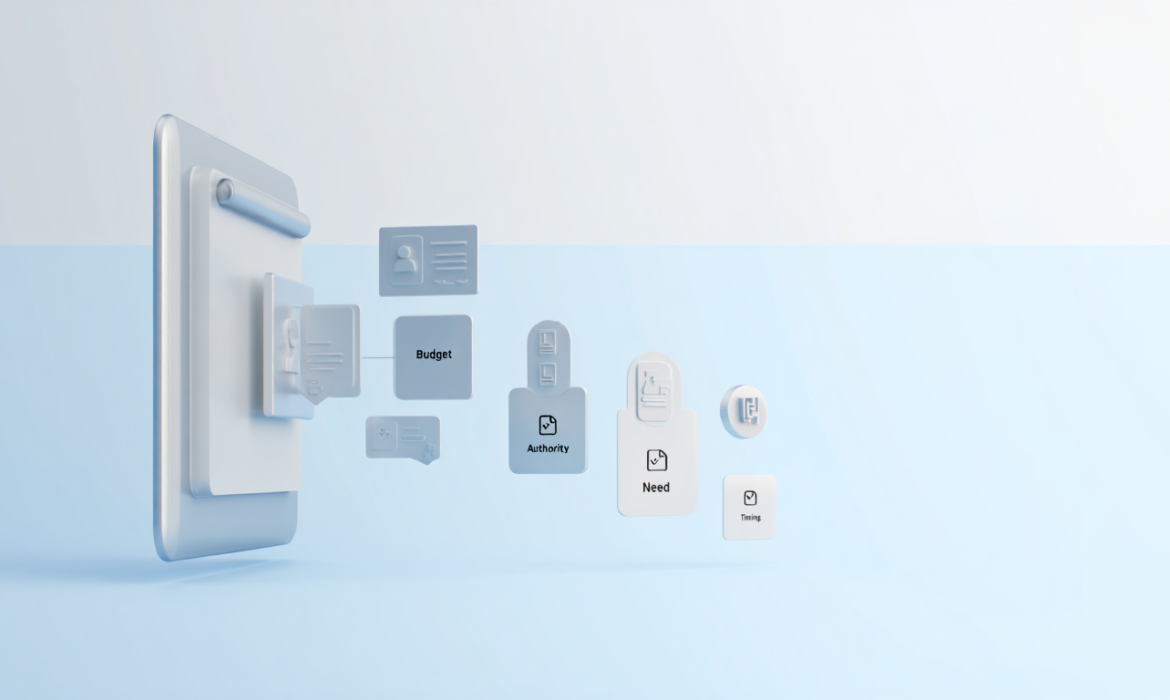
Here’s the core idea: each element of BANT maps to a specific whitepaper strategy.
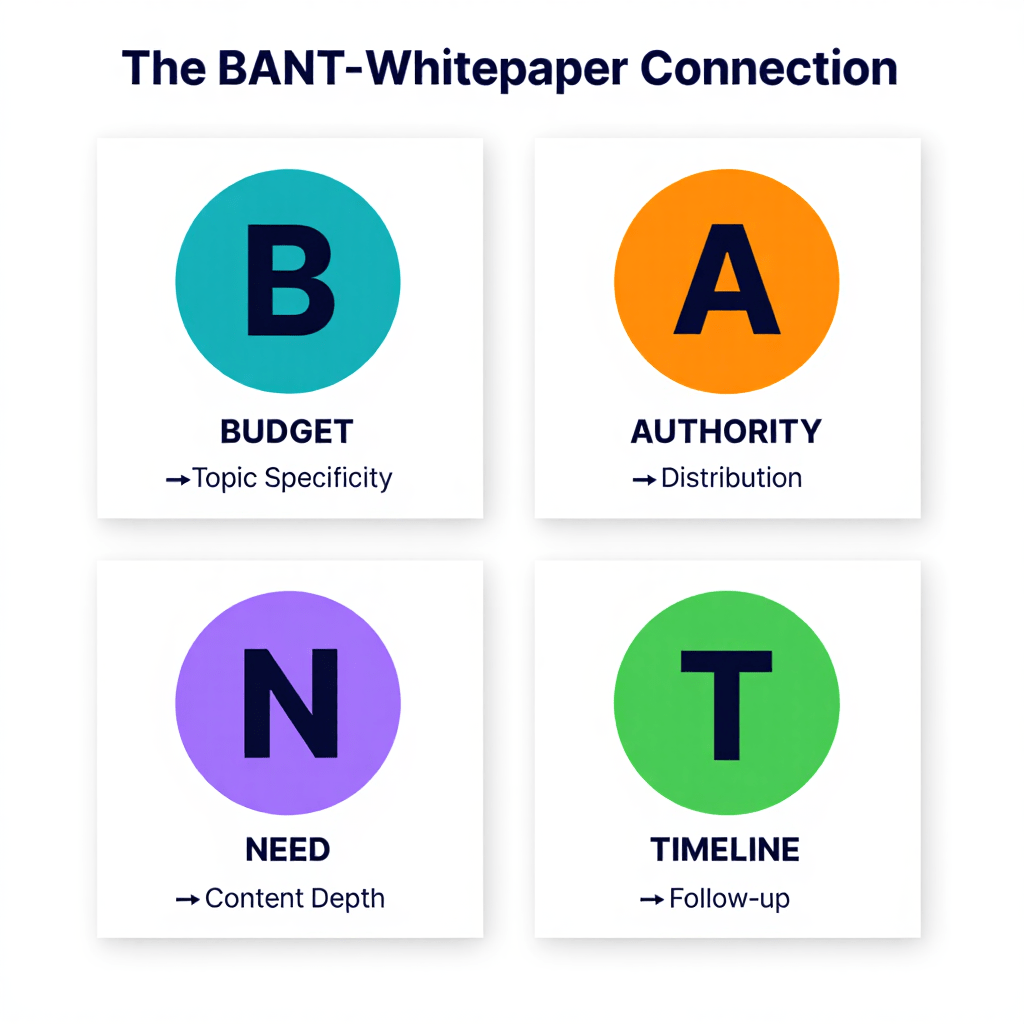
Budget → Topic Specificity
When your whitepaper addresses a problem that has financial consequences, you attract people who understand the cost of inaction. A whitepaper titled “Why Your Current ABM Stack Is Burning Budget” is not going to be downloaded by someone with no budget responsibility.
Topic specificity is your first budget filter. The more precise your pain point, the more senior (and budget-aware) your reader tends to be.
Authority → Distribution Channel
Where you place your whitepaper matters enormously. Publishing it only on your own blog means you’re reaching people who already know you – mostly mid-funnel.
Placing it on third-party B2B media platforms, industry publications, and intent-data networks means you’re reaching decision-makers in the context where they already consume professional content. These are the people with signing authority.
This is why b2b lead generation using whitepapers only truly works when distribution is taken as seriously as content creation. Your whitepaper can be brilliant and still generate zero pipeline if it lives in obscurity on page 4 of your resources section. We’ve covered this extensively in our guide on whitepaper distribution for B2B demand generation – the short version is that channel selection is what separates a pipeline asset from a PDF nobody reads.
Need → Content Depth
Shallow content attracts shallow leads. If your whitepaper reads like a blog post padded to 10 pages, the people who download it have shallow problems. A genuinely in-depth whitepaper that gets specific – with data, frameworks, case studies, and real recommendations – attracts people who are deep in the problem.
Those are the leads worth calling.
Timeline → Gating + Follow-up Sequencing
How you gate your whitepaper and what happens next is your timeline qualifier.
A lead who downloads your whitepaper and opens your follow-up email the same day is different from one who downloaded it six months ago and went cold. Build your follow-up sequence to identify urgency signals: email opens, re-engagement, content re-downloads, page visits after the initial download.
When someone is showing multiple signals in a short window, they’re in-market. That’s your timeline indicator. (More on the exact sequence that works – including why most follow-ups fail – in our breakdown of why whitepaper leads go silent after download.)
Building the Pipeline: Step by Step
Step 1: Choose a Topic That Solves a Costly Problem
Don't write a whitepaper about your product. Write one about a problem your ideal customer loses sleep over.
Ask your sales team: "What's the one thing prospects bring up before they're even ready to talk pricing?" That's your whitepaper topic.
Good whitepaper topics sound like:
- "The Hidden Cost of Manual [X Process] in Mid-Market Companies"
- "Why [Industry] Companies Are Switching Away From [Legacy Approach]"
- "A Practical Guide to [Specific Outcome] Without [Common Obstacle]"
Bad whitepaper topics sound like:
- "Introducing [Your Company]: Our Approach to [Category]"
- "The Future of [Buzzword]"
The difference is specificity and problem-ownership. One makes the reader feel seen. The other makes them feel marketed to.
Step 2: Build for Depth, Not Length
Length doesn't equal quality, but depth does. Your whitepaper should leave the reader with something they didn't have before - a framework, a benchmark, a decision-making tool, a perspective shift.
Structure it like this:
- The Problem (why these matters, with data)
- Why Current Approaches Fail (build credibility by showing you understand their frustration)
- A New Framework or Approach (your POV)
- Evidence (case studies, research, real numbers)
- A Clear Next Step (soft CTA, not a hard sell)
That structure works because it mirrors how a rational buyer thinks through a problem.
Step 3: Place It Where Your Buyers Actually Are
This is where most companies leave pipeline on the table.
They create a great whitepaper, host it on their website, mention it in one newsletter, and then wonder why downloads are low and leads are unqualified.
Strategic whitepaper placement means:
- Syndicating on B2B intent platforms where in-market buyers are actively researching
- Getting featured in industry publications your ICP reads
- Partnering with newsletters that serve your exact buyer persona
- Running targeted paid promotion to the right job titles and company sizes
This is the distribution layer that separates companies with a "content library" from companies with an actual pipeline engine.
If you don't have the infrastructure to do this yourself, working with a specialist makes sense. The team at 24 Media Advert does exactly this - strategic distribution across B2B media networks, industry publications, and intent platforms, so your content actually reaches decision-makers, not just search bots.
Step 4: Gate It Right
The eternal debate: gate or ungated?
My take: gate it, but don't over-ask.
For a BANT pipeline, you need enough information to qualify the lead. That means asking for:
- Name
- Work email (this alone tells you a lot)
- Company
- Job title
That's it. Every extra field you add reduces conversion by 10–20%. You don't need their phone number on the first interaction - you need enough to qualify and follow up intelligently.
If your whitepaper is genuinely valuable, people will fill out four fields. If it's not, no amount of ungating will save you.
Step 5: Score and Route Based on Behaviour
Not every whitepaper download is equal. This is where your BANT qualification gets sharper.
Set up lead scoring based on:
- Company size (from work email domain enrichment)
- Job title (budget holder vs. researcher)
- Behaviour after download (did they open follow-up emails? Did they visit your pricing page?)
- Time-to-engagement (fast signals = higher intent)
Leads that hit a certain score threshold go straight to sales. Lower score leads go into a nurture sequence that keeps them warm until they're ready.
This is how you build a pipeline that your sales team trusts - because the leads coming in have been pre-filtered before anyone picks up the phone. It's also how you start tracking what matters: not download counts, but cost per qualified lead and pipeline influenced. We cover exactly how to measure that in our guide on the real ROI of whitepaper syndication.
The Follow-Up Sequence That Converts
Most companies drop the ball here.
They send a “Thanks for downloading!” email, maybe one follow-up a week later, and then nothing. That’s leaving money on the table.
A proper whitepaper follow-up sequence looks like this:
Email 1 (Immediate): Deliver the whitepaper, set expectations. Keep it short and human.
Email 2 (Day 3): One key insight from the whitepaper + a question. (“Did the section on [specific finding] resonate with what you’re seeing?”)
Email 3 (Day 7): Related resource or case study. Show them you have more depth.
Email 4 (Day 14): Soft CTA. Offer a conversation – not a demo, not a pitch. A conversation. (“If you’re actively thinking through [problem], I’d be happy to share what’s worked for similar companies.”)
Email 5 (Day 30): Re-engagement check. Sometimes buyers go dark because life gets busy, not because they lost interest.
The tone throughout should be helpful, not pushy. You’ve already given them something valuable (the whitepaper). Everything after that is just showing up consistently.
What Good Looks Like: A Real-World Scenario
Imagine you’re a B2B SaaS company selling to operations leaders at manufacturing companies.
You create a whitepaper: “The Real Cost of Manual Compliance Reporting in Mid-Size Manufacturers”
You place it on three industry publications your ICP reads regularly, syndicate it through a B2B intent network, and run a small LinkedIn campaign targeting Operations Directors and VPs at companies with 200–2,000 employees.
Over 90 days, you get 340 downloads.
Of those:
- 180 have work emails from companies in your target size range
- 90 have job titles that match your ICP
- 45 open at least three follow-up emails
- 20 visit your website after the sequence
- 8 book a call
That’s 8 BANT-qualified conversations from a single whitepaper placement campaign. Depending on your ACV, that’s a pipeline worth $400K–$1M+ from one asset.
That math works. And it compounds – because the whitepaper keeps living, keeps being found, keeps generating downloads long after you’ve stopped actively promoting it.
The Mistakes That Kill Whitepaper Pipelines
A few things I see consistently that undermine otherwise good efforts:
Writing for search, not for buyers. SEO whitepapers optimized for keywords but not for actual decision-maker value get downloaded by the wrong people. Write for the human first.
Treating placement as an afterthought. “We’ll promote it later” usually means never. Distribution needs to be planned before the whitepaper is written, not after. As we’ve written before, most whitepapers fail because distribution is an afterthought – not because the content is bad.
No nurture sequence. A whitepaper without a follow-up sequence is just a PDF. The pipeline lives in what happens after the download.
Expecting overnight results. Whitepaper-driven pipelines build over 60–90 days, not 60–90 hours. The leads that come in month three are often more qualified than the ones in week one.
Confusing downloads for pipeline. 500 downloads sound great. But if you can’t trace any of them to actual pipeline movement, you have a vanity metric problem, not a success story. The shift from measuring CPL to tracking CPQL (cost per qualified lead) is the single biggest mindset change B2B marketers need to make – and it’s exactly what separates companies that measure real whitepaper ROI from those who just celebrate download counts.
Generic topics. If your whitepaper topic could apply to any company in any industry, it’s too broad. Narrow it until it feels uncomfortably specific. That’s usually the right level.
Final Thought: Whitepapers Are a Long Game That Pays Well
The reason B2B lead generation using whitepapers keeps working — even as attention spans shrink and inboxes fill up — is because it respects the buyer's intelligence.
You're not tricking anyone. You're not gaming an algorithm. You're creating something genuinely useful, putting it in front of the right people, and letting the quality of your thinking do the qualification work.
That's a sustainable pipeline strategy. Not a hack, not a shortcut — but something that builds trust at scale and brings real buyers to your door.
Ready to Put Your Whitepaper in Front of the Right Decision-Makers?
Creating a great whitepaper is only half the battle. The other half is getting it seen by the people who actually have the budget and authority to act on it.
24 Media Advert’s Whitepaper Placement & Promotion service does exactly that – strategic distribution across B2B media networks, industry publications, and intent platforms, so your whitepaper generates pipeline, not just downloads.
If you’re serious about building a BANT-qualified pipeline, let’s start with where your whitepaper needs to be seen.