Content Syndication vs ABM vs Whitepaper Placement: When to Use Each

If you’ve sat in a budget planning meeting recently, you’ve probably heard some version of this question: “Should we put more into ABM, or is content syndication the better play this quarter?” It’s a reasonable question to ask. It’s also the wrong question.
These three tactics get lumped together because they all live under the demand gen umbrella and they all involve a media partner distributing your message to B2B buyers. But they’re not competing for the same job. Content syndication, account-based advertising, and whitepaper placement solve different problems, and the real skill isn’t picking a winner -it’s knowing which one to pull out for which situation, and how to sequence them so they reinforce each other instead of duplicating spend.
Here’s how to actually think about it.
What each one is actually built to do
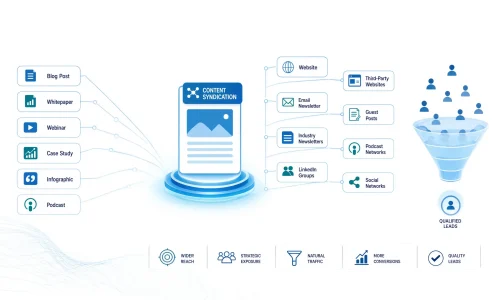
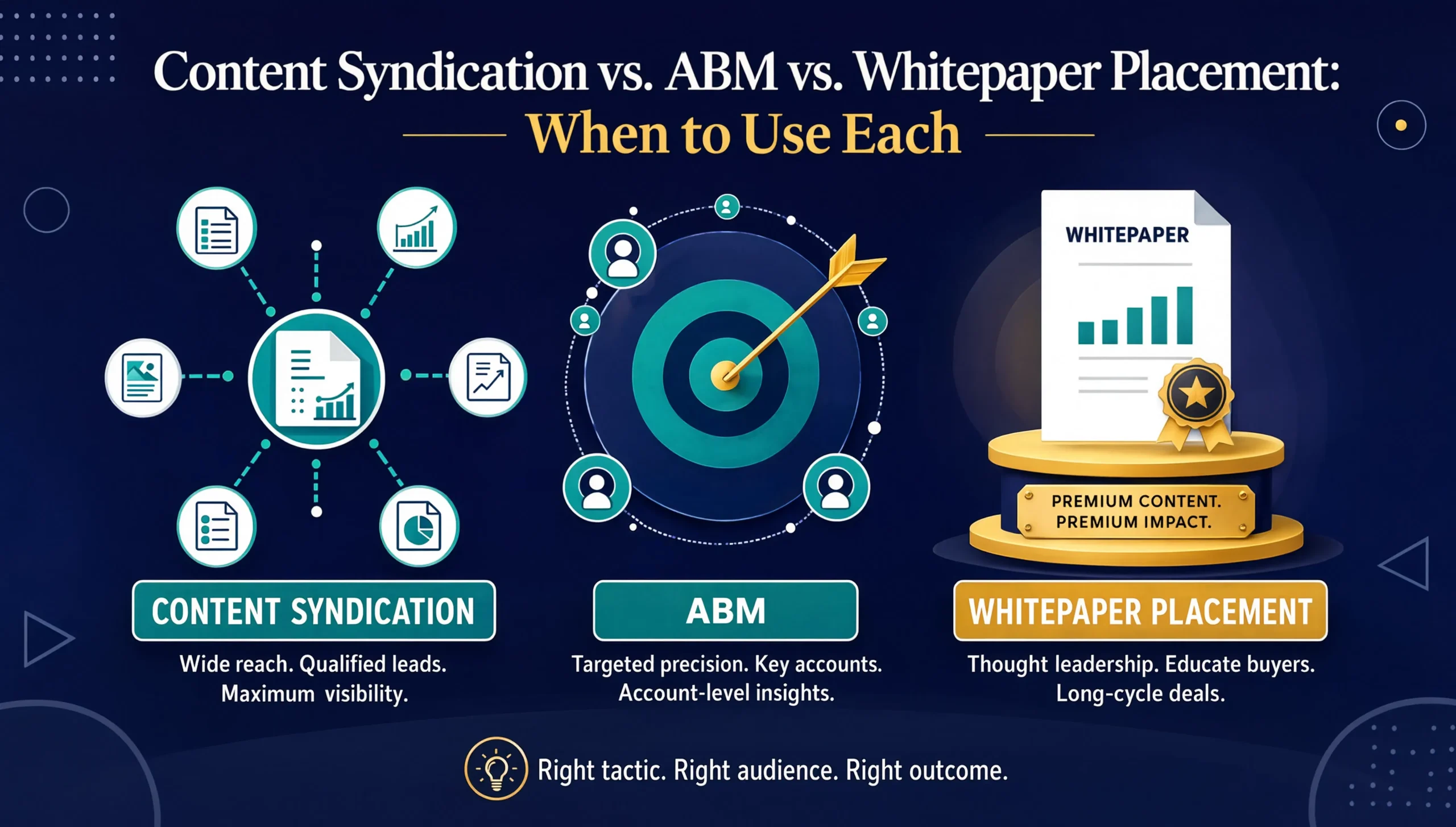
Content syndication takes whatever you’ve already created -blogs, reports, case studies, videos -and gets it in front of your ICP across a wide network of publishers, newsletters, and partner platforms. The content gets reformatted for whatever each channel prefers, and engagement gets tracked back to validated, CRM-ready contacts. The job here is reach with relevance: getting more of the right people exposed to your existing content library without you having to guess where they hang out.
Account-based advertising flips the targeting logic. Instead of casting toward an ICP, you start with a specific list of named companies -accounts your sales team actually wants to land -and run ads aimed only at decision-makers inside those organizations. There’s no broad audience here. If the account isn’t on your list, they don’t see the ad. What you get back isn’t leads in the traditional sense; it’s account-level intent signals showing who’s engaging and warming up.
Whitepaper placement is narrower than both. It’s built around one asset type -a single, research-driven piece of content -and it’s designed for situations where the sale is complicated enough that buyers need real education before they’ll take a call. The targeting maps specific buyer roles (decision-maker, influencer, researcher) and the value isn’t just the download. It’s tracking what happens after the download: how deep the engagement goes, whether the right seniority level showed up, and whether sales gets a warm conversation or another cold contact to chase.
The differences that actually matter
| Content Syndication | Account-Based Advertising | Whitepaper Placement | |
|---|---|---|---|
| Targeting unit | ICP match across open networks | Named account list | Specific roles within target industries |
| Asset type | Any existing content (blogs, reports, video, case studies) | Ad creative pointing to any destination | One in-depth whitepaper or research piece |
| What you get back | Validated, CRM-ready leads | Account-level engagement and intent data | ICP-matched leads with engagement depth |
| Best funnel stage | Top to mid funnel, broad reach | Awareness through pipeline, account-specific | Mid to late funnel, education-heavy |
| Best for | Scaling visibility across a defined buyer profile | High ACV deals with a known target list | Complex, considered purchases with long sales cycles |
| Weak fit for | Sales motions needing precision on specific named accounts | Companies without a defined target account list yet | Mass-market or impulse-driven offers |
When to Use Each
When content syndication is the right call
Reach for this when you have a library of content that’s good but underexposed, and your problem is visibility rather than message-market fit. It’s also the right tool when your ICP is well-defined but your sales team isn’t working from a fixed named-account list -you want volume of qualified contacts, not a narrow set of pre-selected logos. And because placements run across industry publishers and partner networks, it does double duty for brand authority and search visibility, which matters if you’re trying to build topical credibility in a category, not just generate a single campaign’s worth of leads.
It’s a weaker fit when you’ve already identified the exact 50 companies you want this quarter and you need every dollar concentrated on just them. That’s not a syndication problem -that’s an ABM problem.
When whitepaper placement is the right call
This earns its place when you have one strong asset -something genuinely insight-driven, not a generic eBook -and a sales motion where buyers need to be educated before they’ll engage. Long sales cycles, multiple stakeholders, and a price point that requires internal buy-in are all signs this is the right move. It’s particularly effective when your current whitepaper leads go quiet after the download; the tracking here goes past the download event and tells you whether the right seniority level actually engaged with the content, which is usually the missing piece that explains why sales isn’t following up.
Skip this one for low-ticket or impulse-driven offers, or if your content doesn’t actually have a sharp, specific point of view. A generic whitepaper promoted well still under-converts. The narrower and more useful the paper, the better this performs.
The part most comparisons skip these work better in sequence
The framing of “vs.” in the title of this piece is a little misleading, and it’s worth saying so directly. In practice, the strongest B2B pipelines use these three in sequence rather than picking one.
A workable order looks like this: run content syndication broadly to build awareness and figure out which companies are engaging most, then use that engagement data to build (or sharpen) your ABM account list, then deploy a whitepaper placement to the same target accounts once they’re warm enough to want a deeper, more technical conversation. Syndication tells you who’s interested. ABM tells you who’s worth concentrating budget on. Whitepaper placement closes the gap between interest and a sales-ready conversation.
Treating these as three separate line items competing for the same dollars usually means you under-invest in all three. Treating them as stages in one motion is what actually moves accounts through the funnel.
If you’re not sure which stage your current pipeline is weakest at, that’s the more useful question to start with -not which tactic sounds best in a board deck.
Not sure where to start?
Get in touch and we’ll help you figure out which combination fits your current pipeline and account strategy.