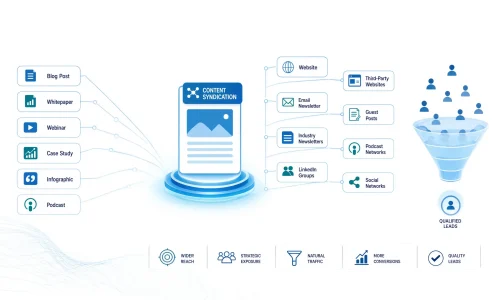
How to Generate High-Quality B2B Leads with Content Syndication

Most B2B marketing teams know what content syndication is. Fewer know how to make it actually work for lead generation – meaning leads that convert, not just leads that land in a spreadsheet and go cold.
This guide is not a definitions piece. It is for marketers who are already running or about to run content syndication campaigns and want to understand what separates programs that generate pipeline from those that generate noise.
We will cover everything from ICP mapping and content selection to lead quality filters, nurture sequences, and ROI measurement – in the order you actually need to think about them.
What Makes a Content Syndication Lead 'High Quality'?
Before you can generate high-quality leads, you need to define what high quality means for your business. This sounds obvious but most teams skip it, and that is why their syndication programs disappoint.
A high-quality content syndication lead has three things:
- Firmographic fit: The company matches your ICP in terms of industry, size, revenue, and geography.
- Intent signal: The person downloaded or engaged with content that reflects an active interest in the problem you solve.
- Contact authority: The person has enough seniority or influence to be part of a buying decision.
If a lead has all three, it belongs in your pipeline. If it has only one or two, it needs to go into a nurture track first.
The biggest mistake in content syndication is treating all form fills as leads. A director-level contact at the wrong company size is not a lead. A perfect-fit company with an intern who downloaded your ebook is not a lead either. Both are data points that need qualification.
Most syndication providers will deliver based on whatever targeting parameters you give them. The tightness of your targeting spec – not the volume of the publisher network – determines lead quality.
Step 1: Build a Precise ICP Before You Brief Any Vendor
The quality ceiling of your content syndication program is set the moment you submit your targeting parameters to a vendor. You cannot improve lead quality after the fact by being more selective in your CRM. The work happens before the campaign goes live.
A practical ICP for content syndication targeting needs to include:
Firmographic parameters
- Industry or sub-industry (use SIC or NAICS codes if your vendor supports it – ‘technology’ is not tight enough)
- Company revenue range or employee count (pick one primary filter, use the other as a secondary)
- Geography down to country and, where relevant, metro or region
- Business model: B2B vs B2C vs B2B2C, as this affects whether your solution is relevant
Contact-level parameters
- Job function: not just ‘marketing’ but demand generation, content marketing, marketing operations, or whatever function actually owns the problem you solve
- Seniority level: Manager, Director, VP, and C-level all behave differently in a buying cycle. Know which ones you need
- Buying authority vs. influencer vs. researcher: all three are valuable but they require different follow-up sequences
Intent layer (if available)
Some syndication vendors can layer third-party intent data on top of their targeting, allowing you to prioritise contacts who are already researching relevant topics. If your vendor supports Bombora or similar intent signals, use them as a secondary filter – not a primary one, since intent data can have a lag.
Rule of thumb: if your targeting spec for a syndication campaign could describe more than 20% of the companies in your addressable market, it is too broad. Tighten it before you spend the budget.
Step 2: Choose Content That Attracts Buyers, Not Just Researchers
In content syndication, the asset you choose to distribute is effectively the bait. What you distribute determines who opts in. This is why many syndication programs generate high volumes of low-quality leads: they distribute top-of-funnel awareness content and wonder why the leads are not ready to buy.
Here is how to think about content selection by funnel stage:
If you want early-stage pipeline
Use research reports, benchmark studies, and industry data. These attract people who are exploring a problem space, not yet evaluating vendors. They generate more volume but longer sales cycles. Good for building your database if your nurture is strong.
If you want mid-funnel intent
Use practical guides, how-to content, and comparison frameworks. The title should reflect a decision the reader is trying to make, not a problem they are just becoming aware of. ‘How to Choose a B2B Data Provider’ will attract people closer to a vendor decision than ‘Why Data Quality Matters.’
If you want sales-ready leads
Use ROI calculators, case studies, and solution-specific whitepapers. These attract people who are already convinced of the category and are evaluating options. Lower volume but significantly shorter sales cycles. Pair with tight ICP targeting for best results.
The title of your asset matters as much as the content inside it. A title that speaks to a specific, urgent business problem will self-select for higher-intent readers. ‘B2B Content Syndication: A Beginner’s Guide’ attracts researchers. ‘How to Reduce CPL in B2B Content Syndication Campaigns’ attracts buyers with a budget problem to solve.
One more consideration: asset format. Whitepapers and benchmark reports consistently outperform blog compilations and general guides in content syndication programs. The perceived value of a gated PDF is higher, which means the person downloading it is more deliberate about it.
Step 3: Set Lead Quality Filters at the Campaign Level
Most content syndication vendors allow you to apply lead qualification criteria before leads are delivered to you. This is one of the most underused levers in the channel.
Common filters you should be using:
Company size filter
If your product is priced for companies with 200+ employees, tell your vendor to exclude anything below that threshold. Do not rely on post-delivery CRM enrichment to catch this. Leads that do not fit your size criteria are not just low-value – they consume SDR time that should go elsewhere.
Job title exclusion list
Every syndication campaign will attract a percentage of students, freelancers, and people who are professionally curious but not buyers. Build an exclusion list of titles you do not want – intern, student, consultant, researcher, assistant – and apply it at the campaign level.
Domain suppression
Remove known competitors, existing customers, and blacklisted domains before the campaign runs. This keeps your lists clean and ensures you are not paying for leads you already have or cannot convert.
Opt-in type
Understand what type of opt-in your vendor is collecting. Single opt-in means the person submitted a form. Double opt-in means they confirmed via email. BANT-qualified leads mean the vendor asked additional qualification questions before passing the lead. Know what you are paying for.
Ask your vendor specifically: what happens if a lead does not meet my firmographic criteria after delivery? Reputable syndication providers will offer lead replacement or credit for out-of-spec leads. If they do not, factor that into your expected yield when calculating CPL.
Step 4: Build a Lead Handoff Process That Does Not Lose Momentum
The window between a content syndication lead being generated and first contact is critical. Research consistently shows that response time in the first hour after a lead is generated significantly increases the likelihood of conversion. In content syndication specifically – where the lead has just engaged with a piece of content – that window is especially short.
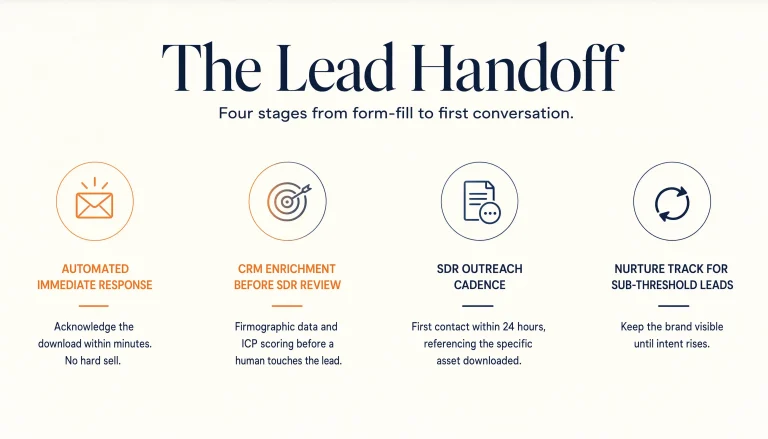
A clean handoff process looks like this:
Automated immediate response
Within minutes of a lead being submitted, they should receive an email that acknowledges the download, delivers the content if not already delivered, and introduces your brand without a hard sell. This email has one job: to make the lead feel like they made a good choice by engaging with your content.
CRM enrichment before SDR review
Before your SDR ever sees the lead, it should be enriched with firmographic data (company revenue, employee count, tech stack if relevant) and scored against your ICP criteria. This takes the manual research burden off your SDRs and ensures they are prioritising the right leads.
SDR outreach cadence
For leads that pass ICP scoring, your SDR should make first contact within 24 hours. The outreach should reference the specific asset the lead downloaded – not a generic ‘I see you visited our website’ message. Specificity here significantly improves reply rates.
Nurture track for sub-threshold leads
Leads that have firmographic fit but low intent signals – or intent signals but incomplete firmographic data – should not be discarded. Route them into a structured email nurture sequence. The goal is to keep your brand visible until their intent increases.
Step 5: Design a Nurture Sequence That Moves Leads Toward a Conversation
Content syndication leads are rarely sales-ready on day one. They opted in to receive content, not to speak with a salesperson. Respect that by building a nurture sequence that earns the right to ask for a conversation.
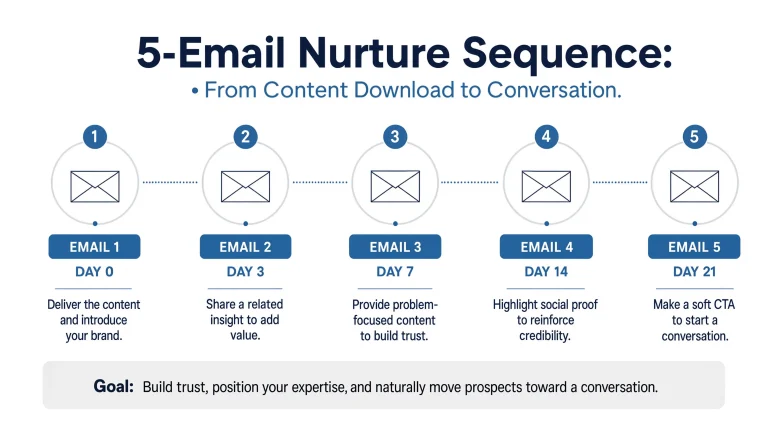
A five-email nurture sequence that works:
Email 1 (Day 0): Content delivery + brand introduction
Deliver the asset. Keep the email short. One sentence about who you are, one sentence about what the content covers, one link. No pitch. No CTA beyond ‘download here.’
Email 2 (Day 3): Related insight
Send a genuinely useful piece of content related to the topic of the original download. A blog post, a data point, a short video. This email proves you are a real resource, not just a lead generation machine.
Email 3 (Day 7): Problem-focused content
Address a specific challenge that your ICP typically faces. This is where you start connecting the problem to your solution – but indirectly. The goal is to make the reader think ‘this company understands my situation.’
Email 4 (Day 14): Social proof
Share a customer result, a case study summary, or a specific metric from a client engagement. Keep it concrete. Vague claims (‘our clients see results’) are ignored. Specific outcomes (‘a mid-market SaaS company reduced their cost per qualified lead by 40% in one quarter’) create curiosity.
Email 5 (Day 21): Soft CTA
This is where you ask for something. But the ask should feel low-friction – a 15-minute call to discuss their situation, a free audit, a specific question rather than a generic ‘can we chat?’ Make it easy to say yes.
The nurture sequence is not the place to show how many features your product has. Every email should answer the question: why is this useful to this specific person right now? If you cannot answer that, the email should not go out.
Step 6: Measure What Actually Matters
Content syndication is frequently measured on CPL (cost per lead). CPL matters, but measuring only CPL will lead you to optimise for the wrong thing: lower-cost leads that never convert.
The metrics that actually tell you whether your program is working:
Lead-to-MQL rate
What percentage of your syndication leads meet your MQL threshold after enrichment and scoring? If this is below 30%, your targeting parameters are too broad. If it is above 70%, you may have room to expand your reach while maintaining quality.
MQL-to-SQL rate
Of the leads that become MQLs, what percentage do your SDRs accept as qualified opportunities? This rate tells you whether your lead scoring model is calibrated correctly. A low MQL-to-SQL rate usually means the scoring model is passing leads that your SDRs are rejecting – a misalignment that needs to be fixed collaboratively between marketing and sales.
Cost per pipeline opportunity
Divide your total syndication spend for a period by the number of pipeline opportunities that were sourced from that spend. This is the number your CFO and CMO actually care about. CPL only matters insofar as it helps you get to this number efficiently.
Content-to-conversion correlation
Which assets are generating the highest-quality leads? Track this at the asset level, not just the campaign level. Over time you will see patterns – certain formats, titles, or topics consistently produce leads that convert better. Double down on those.
Set a 90-day review cadence for your content syndication program. Review your lead-to-pipeline conversion rates by vendor, by asset, and by ICP segment. The programs that consistently improve are the ones where someone is actually looking at this data and making adjustments.
Common Mistakes That Kill Content Syndication Lead Quality
These come up repeatedly across B2B programs, and they are all avoidable:
- Distributing content that has no gating reason – if the asset is freely available on your website, leads have less motivation to engage meaningfully
- Running the same asset to the same audience repeatedly – syndication lead quality drops significantly after the second or third exposure cycle
- Skipping the exclusion list – without competitor, customer, and domain suppression, you are wasting budget on contacts that can never convert
- Treating all vendor networks the same – a publisher with a finance-heavy audience and one with a general tech audience will produce completely different lead profiles even with identical targeting specs
- Not aligning with sales on lead definitions before the campaign – nothing kills a syndication program faster than SDRs rejecting leads that marketing considers qualified
- Measuring success at 30 days – content syndication leads often have longer sales cycles; assessing ROI too early will produce misleadingly negative conclusions
Putting It Together: A Practical Pre-Campaign Checklist
Before your next content syndication campaign goes live, run through this:
- ICP spec is documented and includes firmographic, contact-level, and intent parameters
- Asset selection reflects the funnel stage of the leads you want to attract
- Lead quality filters are applied at the campaign level, not post-delivery
- Domain suppression list is current (competitors, existing customers, blacklisted domains)
- CRM integration is tested and leads will enrich automatically
- Immediate response email is set up and personalised to the asset
- SDR outreach SLA is agreed (e.g., first contact within 24 hours for ICP-fit leads)
- Nurture sequence is live for sub-threshold leads
- Reporting dashboard is set up to track CPL, lead-to-MQL, MQL-to-SQL, and cost per pipeline opportunity
- 90-day review date is in the calendar
Final Thought
Content syndication has a reputation in some marketing circles for being a quantity channel rather than a quality one. That reputation comes from programs that were set up without tight targeting, without lead quality filters, and without a serious nurture strategy.
When you build the program correctly – starting from a precise ICP, choosing content that attracts buyers rather than browsers, and building a handoff process that respects where the lead is in their journey – content syndication becomes one of the most scalable and predictable sources of pipeline in B2B marketing.
The channel works. The work is in the setup.
Ready to build a content syndication program that delivers pipeline, not just leads?
24 Media Advert is a B2B demand generation agency helping mid-market and enterprise marketing teams build content syndication programs that generate verified, ICP-fit pipeline.
From ICP targeting and asset distribution to lead delivery and campaign reporting.