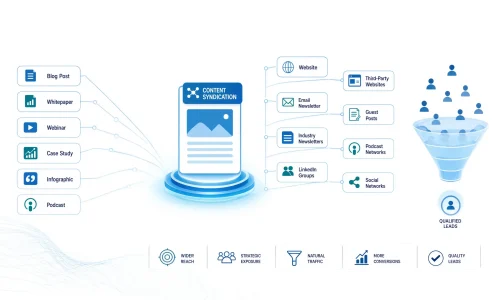
How to Write a Whitepaper That Performs in B2B Content Syndication
Most B2B whitepapers underperform in syndication not because the channel does not work-but because the asset was never built for it. Here is how to write one that generates leads.
When a content syndication campaign underdelivers, the first thing most marketers review is the targeting parameters or the vendor. Rarely do they look at the asset itself.
That is a mistake. The whitepaper is the reason someone fills in a form. The title, the structure, the depth, the specificity-all of it determines whether the right person decides to download it, and whether the lead you get is worth following up on.
If you are planning to run B2B content syndication services or already have a campaign in market, this guide will help you understand what makes a whitepaper perform-and what kills it before it gets a chance.
Why the Asset Determines Lead Quality
Content syndication is a permission-based channel. Someone from your target audience sees your whitepaper listed on a publisher platform or in an email, reads the title, and decides whether it is worth giving up their contact details to get it.
That decision happens in seconds. And everything about it is shaped by the asset: the title signals whether it is relevant to their situation. The topic signals whether it matches where they are in their buying journey. The format signals whether it is worth the time investment.
A broad, generic whitepaper attracts broad, generic leads. A specific, problem-focused whitepaper attracts specific, problem-aware buyers. The targeting parameters you set with your vendor put your content in front of the right audience. The asset itself determines whether that audience responds.
Think of your whitepaper as a self-selecting filter. A strong asset filters in high-intent readers and filters out people who are just browsing. A weak asset does the opposite-high volume, low quality-and no amount of ICP targeting will fix it.
Step 1: Choose a Topic That Matches Buyer Intent, Not Your Messaging
The most common mistake in B2B whitepaper content marketing is writing about what the company wants to say rather than what the buyer needs to know.
Your buyers are not downloading whitepapers to learn about your product. They are downloading them to get a clearer picture of a problem they are dealing with, a decision they are trying to make, or a benchmark they want to compare themselves against.
The right topic for a content syndication whitepaper is one that:
- Addresses a specific, named problem that your ICP actively faces
- Is relevant to where they are in their buying journey, not just where you want them to be
- Has enough substance to justify a gated format-if it can be covered in a 500-word blog post, it should be a blog post
- Is connected-directly or indirectly-to the category your product or service belongs to
The test: would your ICP find this useful even if they never bought from you? If yes, you have a topic worth building. If the answer is only interesting to people who are already considering your product, it is too bottom-of-funnel for broad syndication.
Topics that consistently outperform in B2B content syndication: industry benchmarks, step-by-step operational guides, vendor evaluation frameworks, and research studies with original data. Topics that consistently underperform: product overviews, thought leadership essays without data, and trend pieces without actionable takeaways.
Step 2: Write a Title That Does the Selling Before the Download
In content syndication, your title is your ad. It is the only thing most people will read before deciding whether to download. The body of the whitepaper does not matter if the title does not earn the click.
A strong whitepaper title for syndication does three things simultaneously:
- Names the reader’s situation: who this is for, implicitly or explicitly
- Signals the payoff: what they will be able to do, know, or decide after reading
- Creates specificity: a specific number, timeframe, role, or problem is always stronger than a vague claim
Title formulas that work in B2B syndication
- How to [specific action] without [common obstacle]: ‘How to Scale B2B Lead Generation Without Increasing Headcount’
- The [Role] Guide to [Outcome]: ‘The Demand Generation Manager’s Guide to Content Syndication ROI’
- [Year] Benchmark Report: [Metric] in [Industry]: ‘2026 Benchmark Report: B2B Content Syndication CPL by Industry’
- What [Audience] Gets Wrong About [Topic]: ‘What B2B Marketers Get Wrong About Gated Content’
- [Number] Ways to [Achieve Outcome] in [Timeframe]: ‘7 Ways to Improve Lead Quality from Content Syndication in 90 Days’
What does not work: titles that are clever without being clear, titles that describe the content format instead of the value (‘A Whitepaper on Content Marketing’), and titles that are so broad they could apply to anyone (‘B2B Marketing in 2026’).
Run your title past someone who fits your ICP but is not familiar with your content. If they cannot tell you in one sentence what they would learn from the whitepaper, rewrite the title.
Step 3: Structure for Skimmers, Not Just Readers
B2B buyers are time-poor. They decide whether to keep reading within the first two minutes of opening your whitepaper. If the structure does not make it easy to extract value quickly, they close it-and the signal you wanted to create (that this person is interested in your category) does not materialise in the way you hoped.
A whitepaper built for content syndication should be structured as follows:
Executive summary (1 page)
Open with a one-page summary that covers the core argument, the key findings or takeaways, and who the document is for. This is not a teaser-it is a complete, compressed version of the whitepaper. Busy readers will often only read this page. Make it worth their time.
Problem framing (1–2 pages)
Before you can offer a solution, you need to clearly articulate the problem. This section should make your reader feel seen-they should recognise their situation in what you are describing. Use data, real-world examples, or industry research to establish that the problem is real, widespread, and costly to ignore.
Core content (4–8 pages)
This is the body of the whitepaper-the frameworks, analysis, research findings, or step-by-step guidance that delivers on the title’s promise. Each section should have a clear subheading. Use charts, tables, and callout boxes to break up dense text. Every page should add something new; cut anything that is padding.
Implications or recommendations (1–2 pages)
What should the reader do with what they have just learned? This section translates insight into action. It should feel practical, not promotional. If your product or service is relevant here, you can reference it-but briefly and specifically, not as a hard pitch.
Conclusion and next steps (1 page)
Close with a summary of the key points and a clear indication of what a reader who is ready to act should do next. This is where your CTA belongs-and it should feel earned, not bolted on.
Optimal length for a B2B content syndication whitepaper is 8–14 pages. Shorter than 8 pages and it does not justify a gate. Longer than 14 and completion rates drop significantly, which affects the quality of the engagement signal the lead represents.
Step 4: Lead with Data, Not Opinion
One of the clearest differentiators between whitepapers that generate high-quality leads and those that do not is the presence of original data or credible third-party research.
Data does several things at once in a content syndication context. It makes the asset more shareable-readers forward data-heavy reports to colleagues. It makes the asset more credible-a claim backed by research is more persuasive than an assertion. And it makes the whitepaper harder to replicate, which means it holds its value for longer.
Sources that carry weight with B2B buyers include primary research conducted by your own team (surveys, customer data, campaign benchmarks), and credible third-party sources such as Gartner, Forrester, HubSpot, Bombora, and Salesforce. When citing third-party data, always verify the original source and year-outdated statistics damage credibility.
If you do not have original data, structured frameworks are the next best option. A proprietary model, a decision matrix, or a scoring framework gives the reader something they cannot find elsewhere and positions your company as a thinking leader in the space.
Step 5: Write for Your ICP’s Reading Level, Not Your Internal Vocabulary
A common failure mode in how to write a whitepaper for B2B is writing for internal stakeholders-using company-specific language, product names, or industry jargon that only makes sense if you already understand the vendor’s world.
Your whitepaper will be downloaded by people who have never heard of your company. It needs to make sense to them on first read, in the language they actually use, at the level of familiarity they actually have with the subject.
Practical rules:
- Use the language your ICP uses, not the language your product team uses. If your buyers call it ‘demand gen’ not ‘pipeline acceleration’, write ‘demand gen’.
- Define category-specific terms on first use, even if they seem obvious to you. Not everyone reading your whitepaper on content syndication knows what CPL or MQL means.
- Avoid internal acronyms entirely unless they are standard across your industry.
- Write at a level that a smart, busy professional can follow without re-reading sentences. If a sentence requires more than two readings to parse, rewrite it.
The goal is not to simplify-it is to be clear. Your ICP is intelligent and experienced. What they do not want is to have to work hard to extract value from your content.
Step 6: Design for Credibility, Not Just Aesthetics
In a content syndication context, your whitepaper’s design communicates something before the reader has read a single word. A well-designed document signals that your company takes quality seriously. A poorly designed one-even with great content inside-undermines trust.
You do not need elaborate design. You need consistent, professional execution:
- A clean cover page with a clear title, your company name and logo, and a publication date
- Consistent typography throughout: one font for body text, one for headings, no more
- A visual hierarchy that makes it easy to navigate: clear H1, H2, H3 levels that are visually distinct
- Data visualised as charts or tables rather than described in dense paragraphs
- Pull quotes or callout boxes to highlight key statistics or insights
- Your brand colours used sparingly and consistently-not as wallpaper
One formatting rule specific to syndication: always include a page number, your company URL, and a copyright notice in the footer. When your whitepaper is downloaded and shared, it will travel further than your distribution network. Make sure it carries your brand wherever it goes.
Step 7: Place Your CTA Where It Will Actually Be Seen
Most B2B whitepapers bury the call to action on the last page, after a reader has already decided whether they are interested in talking to you. That is too late, and too passive.
In a whitepaper built for content syndication, your CTA should appear in at least two places:
- Once in the body, contextually: At a natural moment where your product or service is directly relevant-for example, after a section on a problem your solution addresses. Keep it brief: one or two sentences and a specific next step.
- Once at the end, as a dedicated section: A short paragraph summarising what the reader should do next if they want to take action. This is where you can include a link, a contact detail, or a specific offer.
What the CTA should say: something specific, low-friction, and relevant to what they just read. ‘Contact us to learn more’ is not a CTA-it is a placeholder. ‘See how we run content syndication campaigns for B2B demand generation teams’ is a CTA.
The best CTAs in B2B whitepapers do not ask for a sale. They ask for a next step that is proportionate to where the reader is likely to be in their journey. A reader who just downloaded a whitepaper is not ready to book a demo. They may be ready to read a case study, explore a service page, or get on a short introductory call.
Whitepaper Best Practices: A Pre-Publication Checklist
Before you submit your whitepaper to a syndication vendor or begin distribution, run through this:
- Title passes the ICP test-someone who fits your buyer profile can tell immediately what they will learn
- Topic is specific enough to justify a gate-it cannot be covered adequately in a single blog post
- Executive summary stands alone-a reader who only reads this page will still find it valuable
- Data and statistics are sourced, verified, and dated
- No internal jargon or acronyms that require insider knowledge to understand
- Structure uses clear subheadings throughout-a reader can navigate by skimming
- Design is clean, consistent, and includes your URL and logo on every page
- CTA appears twice-once contextually, once at the end
- Length is between 8 and 14 pages
- Asset is not freely available on your website without a gate
One More Thing: Distribution Shapes Performance Too
Even the best-written whitepaper will underperform if it is distributed to the wrong audience. Once your asset is ready, the next decision is where and how to syndicate it. If you are evaluating options, our roundup of the best content syndication providers for B2B in 2026 covers the key vendors, what they offer, and how to choose between them based on your ICP and budget.
And if you want to go deeper on the asset format itself, whitepaper syndication as a standalone service-rather than as part of a broader content syndication program-is worth understanding before you decide how to distribute.
The Short Version
A whitepaper that performs in B2B content syndication is not just well-written-it is built for the specific context of the channel. That means a title that earns the download, a topic that matches buyer intent, a structure that respects how busy professionals actually read, and a CTA that asks for the right next step at the right moment.
The asset is your first impression with every lead your syndication program generates. Write it like it matters-because in a channel where you are paying per lead, it directly determines the quality of every contact in your pipeline.