
What Is Content Syndication? How It Works for B2B Lead Generation
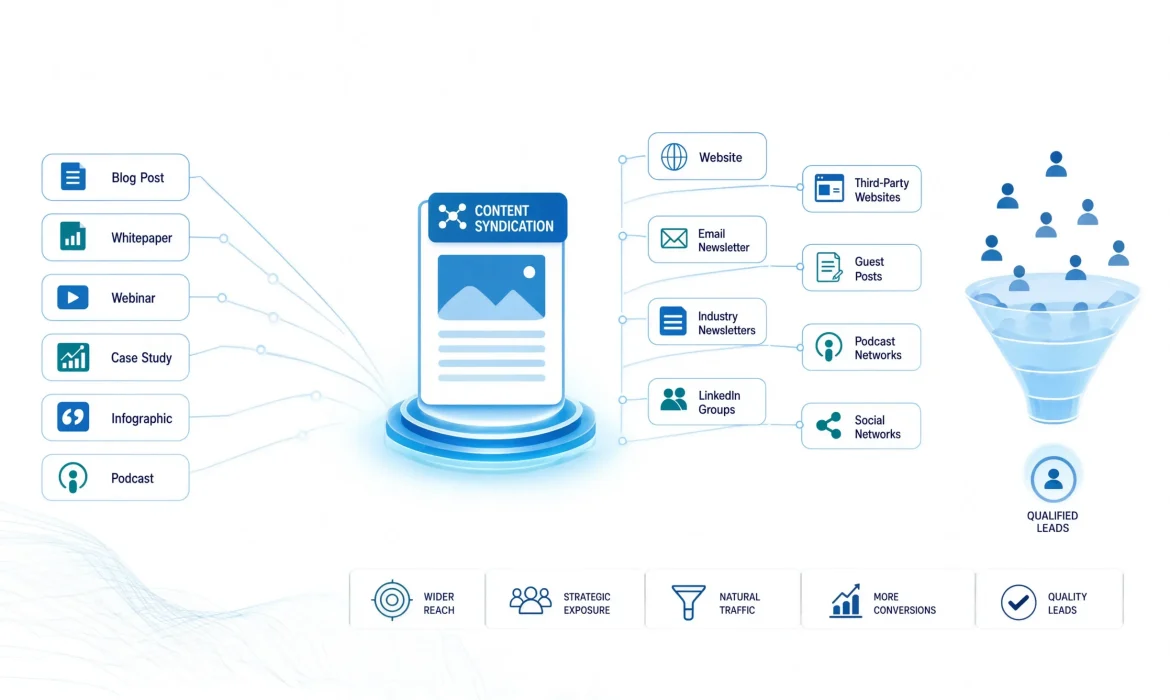
A foundational guide for B2B marketers who want to understand the channel before they invest in it -and for those already running programs who want to make sure they have the basics right.
If you have been in B2B marketing for more than five minutes, you have heard the term content syndication. But depending on who you ask, you will get a different definition. Some describe it as paid distribution. Others call it lead generation. A few confuse it with content marketing altogether.
This piece gives you the clear, practical version: what content syndication actually is, how the mechanics work, what it is not, and whether it belongs in your demand generation mix.
No filler. No vendor pitch masquerading as education. Just a straight answer to a question that deserves one.
The Simple Definition
Content syndication is the process of distributing your existing content -whitepapers, ebooks, research reports, guides -through third-party publisher networks to reach audiences beyond your own channels.
In B2B, it works like this: a vendor or publisher network places your content asset on their platform or sends it to their subscriber list. When someone from their audience downloads or engages with your content, that person’s contact details are captured and passed to you as a lead.
You pay for the leads generated -either on a cost-per-lead (CPL) basis or through a fixed campaign fee -not for impressions or clicks.
The key distinction between content syndication and most other digital channels: you are paying for a known action (a content download by a named, contactable individual), not for eyeballs or traffic. That makes it a fundamentally different type of investment than display advertising or SEO.
How Content Syndication Actually Works: Step by Step
The mechanics are straightforward once you understand each component. Here is how a typical B2B content syndication campaign runs from start to finish.
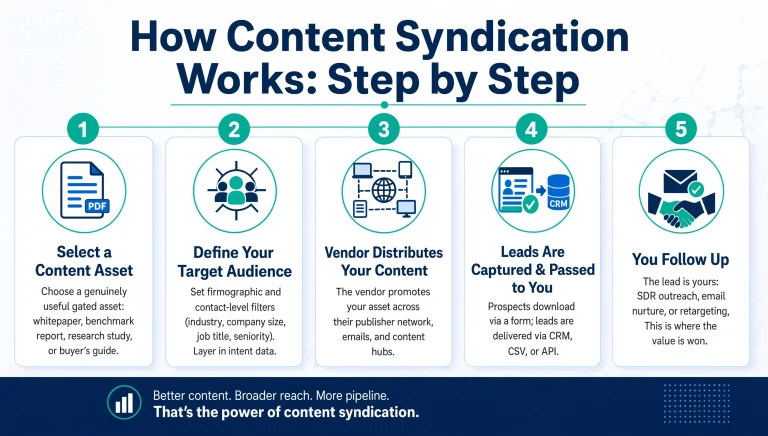
Step 1: You select a content asset
The campaign starts with a piece of content worth gating -typically a whitepaper, benchmark report, research study, buyer’s guide, or solution brief. The asset needs to be genuinely useful to the audience you are trying to reach. Thin content attracts thin leads.
Step 2: You define your target audience
You work with a syndication vendor to specify the audience you want to reach. This typically includes firmographic filters (industry, company size, revenue, geography) and contact-level filters (job function, seniority level, job title). Some vendors can also layer intent data on top, so your content is prioritised for contacts who are already showing research behaviour in your category.
Step 3: The vendor distributes your content
The syndication vendor places your content asset -or promotes it -across their publisher network. This might mean it appears as a recommended download on a relevant trade publication, gets emailed to a segment of their opt-in subscriber database, or is featured on a content hub that their audience visits for research.
The person engaging with your content may not know it is your brand behind the download until they see the asset itself. They are responding to the content topic, not to you specifically. That is not a problem -it is actually useful, because it tells you their interest is genuine.
Step 4: Leads are captured and passed to you
When someone downloads your asset, the vendor captures their contact information through a form. The required fields depend on what you have agreed with the vendor -at minimum, name, email, company, and job title. Some programs include phone number, company size, or BANT qualification questions.
Leads are then delivered to you, usually through a CRM integration, a CSV file, or a direct API feed, depending on the vendor’s capabilities.
Step 5: You follow up
The lead belongs to you. What happens next -whether they hear from an SDR, go into an email nurture sequence, or land in a retargeting audience -is entirely your decision. Most of the value (or lack of it) in content syndication comes from what happens at this stage.
Content syndication generates the lead. Your follow-up strategy determines whether it becomes pipeline. Treating these as separate problems -owned by different teams with different goals -is the single most common reason syndication programs underperform.
What Content Syndication Is Not
Because the term gets used loosely, it is worth being precise about what content syndication is not -and how it differs from channels it is frequently confused with.
It is not content marketing
Content marketing is about creating content that attracts an audience to your own channels over time. Content syndication is about distributing existing content through someone else’s channels to generate leads immediately. They can complement each other, but they serve different functions and have different timelines.
It is not programmatic advertising
Programmatic ads serve display or video creative to audiences across publisher networks and charge on a CPM or CPC basis. You are paying for exposure. Content syndication charges on a cost-per-lead basis and delivers contactable individuals who have actively engaged with your content. Fundamentally different intent and measurement model.
It is not account-based marketing (ABM)
ABM starts with a defined account list and works backward to reach specific companies. Content syndication typically starts with demographic and firmographic parameters and surfaces leads from within that target universe -you do not necessarily know in advance which companies will engage. The two strategies work well together (syndication can be used to reach named accounts), but they are not the same thing.
It is not organic content distribution
Publishing your blog post on LinkedIn or syndicating an article to a trade publication for editorial placement is a form of content distribution, but it is not lead-generating content syndication in the B2B demand gen sense. In that model, you are not getting contactable leads in return for your content -you are getting exposure.
The Types of Content That Work Best for Syndication
Not all content performs equally in a syndication program. The format, depth, and topic all affect the quality of leads you attract.
Whitepapers and research reports
The highest-performing format in most B2B syndication programs. They signal depth, require a meaningful time investment to consume, and attract readers with a genuine interest in the subject matter. Original research with real data performs especially well -it gives the reader something they cannot get elsewhere.
Benchmark and survey reports
Industry benchmarks are consistently high-value for syndication because they answer questions buyers are already asking: how does our performance compare? What are others in our category doing? These attract decision-makers who are actively evaluating their current approach.
Buyer’s guides and evaluation frameworks
Content that helps a buyer navigate a purchase decision -how to evaluate vendors, what questions to ask, what criteria to weight -attracts people who are already in a buying cycle. Lower volume than awareness content, but significantly higher conversion rates.
Solution briefs and use-case documents
More bottom-of-funnel and lower volume, but useful when combined with tight ICP targeting. The person who downloads a solution brief already understands the category and is evaluating options. These leads are closest to sales-ready.
A common mistake is syndicating the same content you publish freely on your website. If the asset is already available without a gate, the perceived value of filling in a form to get it drops significantly. Use syndication for content that justifies the exchange.
Where Content Syndication Fits in the B2B Funnel
Content syndication is often described as a top-of-funnel channel, but that is only partially accurate. Where it sits in your funnel depends entirely on what you syndicate and to whom.
- Awareness content (industry trends, market overviews) distributed broadly attracts early-stage researchers. High volume, longer nurture required.
- Practical guides and how-to content attract mid-funnel buyers who are trying to solve a specific problem. Medium volume, moderate sales cycle.
- Solution-specific whitepapers and ROI frameworks distributed with tight ICP targeting attract late-stage evaluators. Lower volume, shorter sales cycle.
The mistake most teams make is running awareness content and expecting sales-ready leads. Align your asset choice with the funnel stage of the leads you actually want, and your syndication program will behave very differently.
The Business Case for Content Syndication in B2B
Why do B2B marketing teams use content syndication instead of -or alongside -other lead generation channels? A few reasons stand out.
Reach beyond your existing audience
Your owned channels (website, email list, social following) can only reach people who already know you exist. Content syndication puts your content in front of audiences you have not yet reached -people who are actively researching relevant topics but have never encountered your brand. For companies with limited organic reach, this is one of the fastest ways to build pipeline.
Predictable lead volume at a known cost
Unlike SEO or content marketing, which have unpredictable timelines and outputs, content syndication delivers a known number of leads at a known cost per lead. If you need 100 ICP-fit leads in the next 60 days and you have a budget to support it, a well-structured syndication campaign can deliver that with a high degree of confidence. That predictability is valuable for pipeline planning.
Content leverage
If you have already invested in creating a high-quality whitepaper or research report, content syndication multiplies the return on that investment. The asset does not sit on your website waiting for organic traffic -it gets actively distributed to the exact audience you want to reach.
Audience intelligence
Every content syndication campaign generates data about who is engaging with your content. Which job titles downloaded most? Which industries responded? Which company sizes appeared most often? That data informs your ICP, your content roadmap, and your sales targeting -even before a single lead converts.
What to Watch Out For
Content syndication works well when it is set up correctly. It underperforms when these common issues are not addressed upfront.
Broad targeting parameters
The quality of your leads is directly proportional to the tightness of your targeting spec. A syndication campaign that targets ‘technology companies with 50+ employees’ will produce a very different lead set than one targeting ‘B2B SaaS companies with 200-1,000 employees in financial services.’ Build your ICP before you brief your vendor.
No lead quality filters
Most vendors allow you to apply exclusion criteria -removing competitors, existing customers, specific job titles, or company sizes that do not fit your ICP. If you do not use these filters, you will pay for leads that should never have entered your pipeline. Set them at the campaign level, not post-delivery.
Weak follow-up
A content syndication lead has engaged with a piece of content. They are not necessarily ready to buy. If your follow-up is a generic sales call within 10 minutes of form submission, you will damage the relationship before it starts. Build a nurture sequence that respects where the lead is in their journey and earns the right to a conversation.
Measuring the wrong metrics
Cost per lead tells you how efficiently you are generating contacts. It does not tell you whether those contacts are worth anything. Measure lead-to-MQL rate, MQL-to-SQL rate, and cost per pipeline opportunity. Those are the numbers that tell you whether your syndication program is actually working.
Is Content Syndication Right for Your Business?
Content syndication works best when certain conditions are in place. It is worth asking honestly whether those conditions exist before committing budget.
- You have a clearly defined ICP with specific firmographic and contact-level criteria.
- You have -or can create -a content asset that provides genuine value to that ICP.
- You have a follow-up process (SDR team, email nurture, or both) that can handle inbound leads within 24-48 hours.
- You are comfortable with a channel that generates early-to-mid funnel leads that require nurturing before they are sales-ready.
- You need to reach audiences beyond your existing organic reach.
If those conditions are true, content syndication is one of the most scalable and cost-predictable lead generation channels available in B2B marketing. If they are not, address them before you invest -the channel will not compensate for an unclear ICP or a broken follow-up process.
The Short Version
Content syndication is the paid distribution of gated content assets through third-party publisher networks to generate B2B leads. You define your target audience, a vendor distributes your content to that audience, and you receive the contact details of people who engaged with it.
It is not content marketing, not programmatic advertising, and not ABM -though it can complement all three. It works best when your ICP is tight, your content is genuinely valuable, and your follow-up is built to convert interest into pipeline over time.
The channel is not complicated. Executing it well requires attention to targeting, content selection, lead quality filters, and what happens after the lead is delivered. Get those four things right and content syndication becomes one of the most reliable sources of predictable pipeline in your demand generation mix.