How to Build a Verified B2B Email List Without Damaging Your Domain Reputation
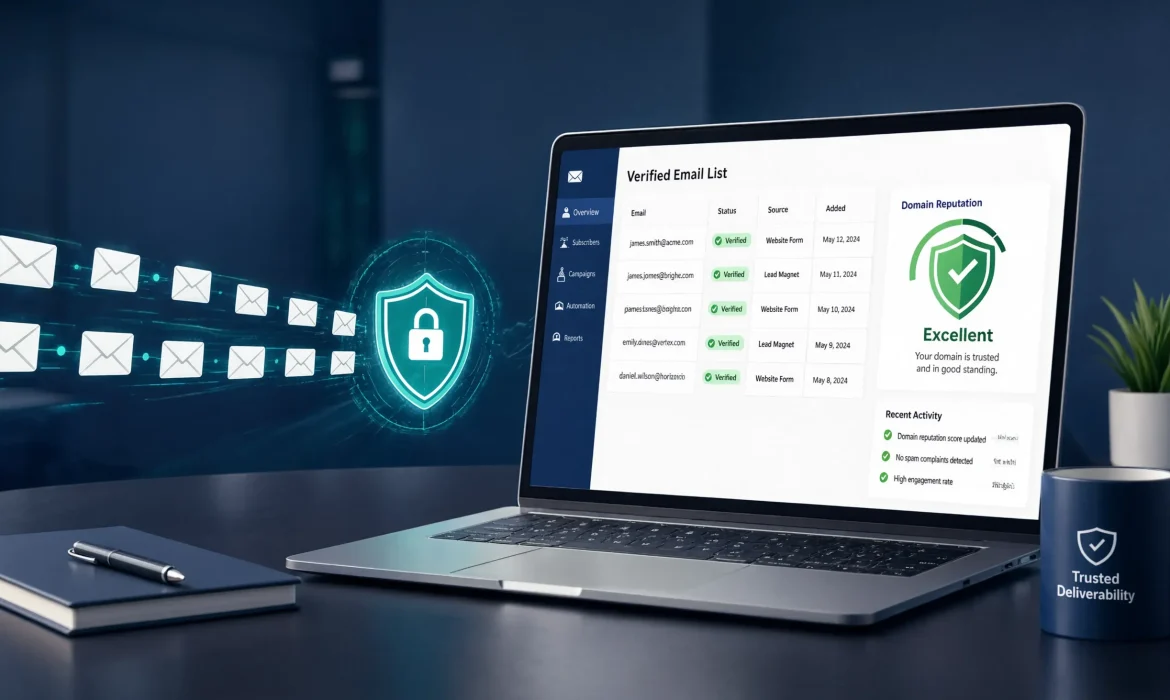
A verified B2B email list is one where every contact has been checked against multiple signals – current employment, working email address, accurate title – before it ever reaches a sending sequence. It’s not the same as a “targeted” list, and it’s definitely not the same as a purchased contact database. You can have a perfectly targeted list, built around the right industries and job titles, and still tank your deliverability if the underlying data is stale.
This distinction matters more than most B2B teams realize, and the data backs that up. Industry research consistently points to B2B contact databases decaying somewhere between 20% and 30% a year, largely driven by job changes – the average professional tenure has dropped to around four years, and it’s shorter still in tech and SaaS. Email-specific decay tracks close behind, with recent industry benchmarks putting it in the low-to-mid 20% range annually. That means a list built and left untouched for twelve months has a meaningful chunk of dead weight in it before you’ve sent a single campaign.
Here’s my honest take after watching this play out across a lot of campaigns: most teams treat list building as a sourcing problem. Buy the right database, filter by the right criteria, done. It’s not a sourcing problem. It’s a maintenance problem wearing a sourcing costume.
Verified Doesn't Mean What Most Vendors Say It Means
This is where I’ll push back on how the term gets used. A lot of “verified” contact databases are verified once, at the point of data collection, and then sold repeatedly for months or years afterward. The verification happened. It just happened a long time ago, and the data has been decaying ever since.
Real verification is closer to a process than a status. It means checking that an email address is technically deliverable (not bouncing, not a catch-all trap), confirming the person still holds the role they’re listed under, and cross-referencing recency – when was this record last touched or updated. A list that passes all three checks the week before a campaign launch is verified. The same list six months later isn’t, even if nothing about the label on the file has changed.
The practical implication: if your list provider or agency can’t tell you when a record was last verified, treat the whole file as unverified. Age is the single biggest predictor of whether a “verified” contact is still accurate.
Why Bad List Data Damages Deliverability, Not Just Response Rates
Most people assume the cost of a stale list is wasted effort – you email people who aren’t there anymore, you get no reply, you move on. That’s the visible cost. The invisible cost is worse.
Every bounce from an invalid email address is a signal to inbox providers that you’re sending to addresses you shouldn’t have. Enough of those signals, and your sending domain’s reputation takes a hit – the same reputation that determines whether your legitimate, well-targeted emails land in the inbox or get filtered before anyone sees them. This is the connection most teams miss: list quality and deliverability aren’t separate problems. A stale list can sabotage a perfectly good sending infrastructure; the same way bad infrastructure can sabotage a perfectly good list. We covered the infrastructure half of this in an earlier post – the list half is just as important, and far more commonly overlooked.
This is also why “just buy a bigger list” is close to the worst advice in B2B email marketing. A bigger, unverified list doesn’t generate more replies. It generates more bounces, faster reputation decay, and worse results on every subsequent send – including ones to contacts who were actually valid.
What ICP-Based List Construction Actually Looks Like
Building a verified list around an ideal customer profile is different from filtering a generic database by industry and job title, though they can look similar on the surface.
ICP-based construction starts with defined boundaries – industry, company size, seniority, and often technology stack – and builds the list from there, checking each record against those criteria individually rather than pulling a bulk export that loosely matches. This tends to produce a smaller, slower-to-build list than a generic database pull. That’s the trade-off, and it’s usually worth it: a smaller list of verified, well-matched contacts consistently outperform a larger list of loosely matched, unverified ones, both in reply rate and in the deliverability data that protects future campaigns.
The other piece people underestimate is technographic matching – knowing not just who a company is, but what tools and platforms it already runs. A prospect using a competing solution or a clearly incompatible tech stack is a targeting miss even if every other criterion matches. This kind of filtering is slower to do well, which is exactly why a lot of vendors skip it and lean on firmographic filters alone.
List Hygiene Is a Process, Not a Cleanup
The mistake I see most often: teams treat list verification as a one-time gate before the first campaign, then never touch the list again. Given how fast B2B contact data decays, that’s roughly equivalent to verifying it once and then slowly, invisibly, letting a fifth of it go bad by the time you’re running your fourth or fifth sequence.
A better approach treats hygiene as continuous. That means re-checking bounce and engagement signals after every send, pruning contacts who’ve gone consistently unresponsive across multiple attempts, and refreshing records on a set cadence rather than waiting for a problem to show up in the numbers. It’s less exciting than sourcing new contacts, and it’s the part of the process most likely to get skipped under deadline pressure. It’s also the part that determines whether your sending domain still has a good reputation six months from now.
If list quality is the gap in your outbound strategy, 24 Media Advert’s targeted email marketing services build lists from verified, hand-picked profiles matched to your ICP – not static databases sold long after the verification happened. This post builds on our earlier posts on why cold email lands in spam and in-house infrastructure vs. third-party tools – list quality is the third leg of the deliverability stool, alongside infrastructure and sending discipline.
Frequently Asked Questions
How often should a B2B email list be re-verified?
For active outbound programs, monthly re-verification is a reasonable baseline, with continuous monitoring of bounce and engagement signals between full refreshes. Lists sitting idle for longer stretches should be re-verified before any new campaign launches, regardless of how recently they were originally built.
Does a smaller, verified list outperform a larger, unverified one?
Generally, yes. A smaller list with accurate, current data produces better reply rates and protects sender reputation, while a larger unverified list tends to generate higher bounce rates that damage deliverability for every campaign that follows.
What’s the difference between a targeted list and a verified list?
Targeting defines who should be on the list, based on criteria like industry, seniority, and company size. Verification confirms that the specific contacts on that list are current and reachable. A list can be well-targeted and still be unverified, which is a common and underappreciated failure point in B2B email marketing.