
Targeted Email Marketing vs. ABM Email Campaigns: Which Fits Your Pipeline Goals?
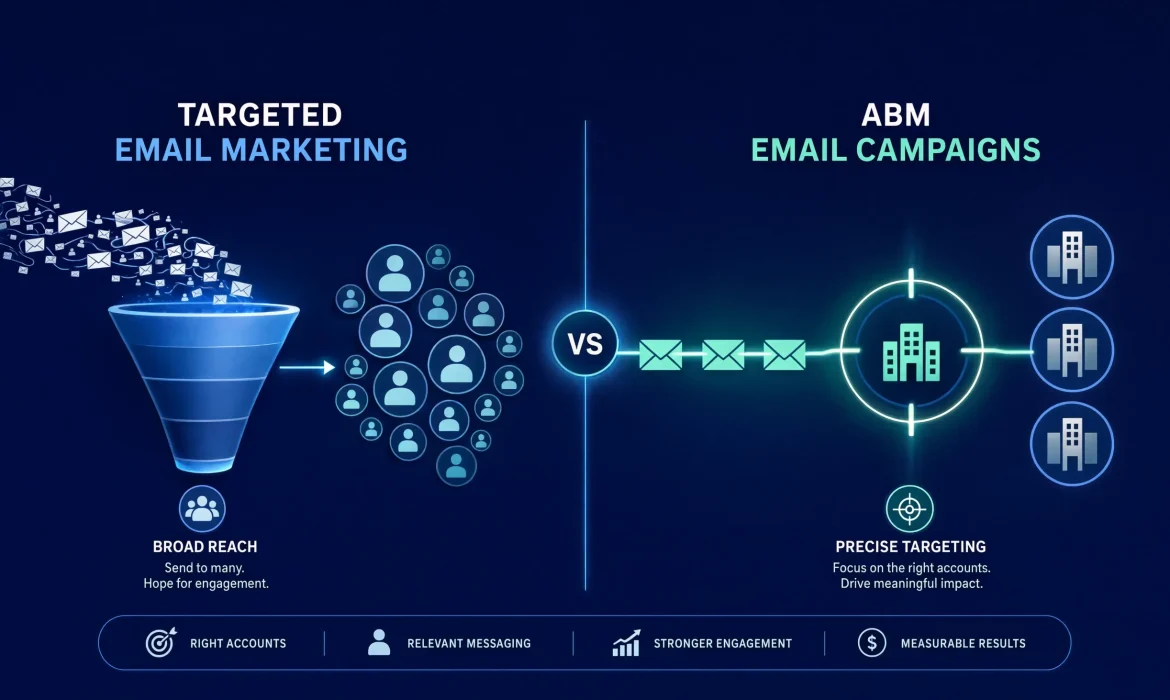
The core difference between targeted email marketing and ABM comes down to reach versus depth. Targeted email marketing builds a large, well-qualified list around shared characteristics -industry, seniority, tech stack -and runs campaigns designed for volume of qualified conversations. ABM narrows to a small set of named accounts and builds highly personalized, often one-to-one campaigns for each. Neither approach is objectively better. They’re built to solve different pipeline problems, and picking the wrong one for your situation is a more common mistake than people admit.
Here’s how to make that call, backed by where the current data lands on each approach.
The Real Deciding Factor: Deal Size and Total Addressable Market
Most comparisons of ABM versus broader outbound get stuck on tactics -personalization depth, channel mix, tooling. The more useful lens is economic: what’s your average deal size, and how many companies could realistically buy from you?
Industry guidance in 2026 converges on a rough threshold. One analysis puts the ABM breakeven point around $15,000 in annual contract value, with anything below that better served by broader outbound because per-account personalization costs don’t pencil out. A separate framework from a lead generation agency draws the line closer to $30,000 ACV, noting that everything above becomes uneconomical without ABM discipline, and everything below is better served by broad outbound. The exact number moves depending on your sales motion and margins, but the direction is consistent: below a certain deal size, the cost of deep personalization outweighs what any single account is worth.
TAM size matters just as much as deal size. ABM assumes a total addressable market small enough to list out by name -most mature 2026 programs work off tier-1 lists of 30 to 200 high-fit accounts, a sharp pull-back from the bloated 500-1,000+ account lists that were common a couple of years ago. If your addressable market is a few hundred companies total, ABM’s precision makes sense. If it’s tens of thousands, no amount of personalization budget makes one-to-one economical, and targeted email’s ability to reach qualified volume becomes the only realistic path to pipeline.
What ABM Actually Delivers, When It's the Right Fit
It’s worth being honest about why ABM has become the default recommendation for enterprise motions -the results, when the fit is right, are genuinely strong.
Multiple 2026 datasets point in the same direction. One analysis citing ABM Leadership Alliance and Demandbase data found ABM-led programs generate 2.6 times more pipeline per marketing dollar than broad-reach demand gen, with 41% higher win rates and 33% larger average deal sizes once an account converts. A separate 2026 playbook analysis reported similarly -companies running mature ABM programs see roughly 40-50% faster sales cycles on target accounts and 25-35% higher deal sizes compared to non-ABM cohorts.
The gap widens further up-market. That same research noted the difference between ABM and broad-reach performance is most pronounced in Fortune 1000-class enterprise deals, where buying committees are large and per-account investment is easiest to justify.
None of this means ABM is simply “better.” It means ABM’s cost structure only makes sense when deal value and buying committee complexity justify the investment per account. Applied to a $5,000 ACV product with a broad TAM, that same personalization intensity is a way to burn budget slowly.
What Targeted Email Marketing Delivers Instead
Targeted email marketing isn’t a lesser version of ABM run at scale -it’s solving a genuinely different problem: generating qualified pipeline volume across a market too large for one-to-one treatment.
This is where the earlier posts in this series connect directly. A well-run targeted email program depends on the same fundamentals we’ve covered -verified, ICP-matched lists, sending infrastructure that protects deliverability, and reply rate benchmarks in the 2-5% range for senior decision-makers. None of that requires the per-account research and cross-functional coordination ABM demands. It requires disciplined targeting at the segment level, not the individual account level, which is exactly what makes it viable across a broad TAM.
The trade-off is real and worth naming plainly: targeted email won’t produce the deal-size lift or win-rate improvement ABM delivers on a well-chosen account list. What it produces instead is pipeline volume at a cost structure that works when your addressable market is thousands of companies rather than a few hundred.
Can You Run Both? Most Mature Teams Do
This is one of the more consistently repeated points across current ABM guidance, and it matches what we see working in practice: ABM and broader outbound aren’t competing strategies, they’re complementary ones aimed at different slices of the same funnel.
One 2026 analysis frames it well inbound and broad outbound fill the top of the funnel and produce qualified leads, while ABM is a layer applied once an account from any source shows fit and intent. It’s additive to the funnel, not a replacement for it. In practice, this usually looks like ABM concentrated on a tier-1 list of your highest-value named accounts, with targeted email marketing running in parallel to cover the much larger pool of accounts that fit your ICP but don’t individually justify one-to-one treatment.
The failure mode to avoid is applying ABM-style intensity across your entire funnel. Diluting one-to-one personalization across a broad, unranked account list -sometimes called tier collapse -is a documented way ABM programs underperform. The same discipline that makes ABM work on 100 accounts breaks down completely if applied to 5,000.
A Quick Way to Decide
If you’re still unsure which approach fits, three questions tend to settle it:
Is your total addressable market small enough to list by name?
If you can realistically name every company that could buy from you, ABM is viable. If your TAM runs into the thousand’s, targeted email is the more economical starting point.
Does your average deal size justify per-account investment?
Above roughly $15,000-$30,000 ACV, ABM’s cost structure starts to make sense. Below that, broader outbound consistently wins on unit economics.
Do your buying committees require individual coordination, or can a segment-level message work?
Large, multi-stakeholder enterprise deals benefit from ABM’s account-level coordination. Simpler buying processes with fewer stakeholders are well served by targeted email’s segment-based approach.
If you’re trying to figure out where targeted email marketing fits into your broader pipeline strategy, 24 Media Advert’s targeted email marketing services are built for exactly the volume-and-scale side of this equation -verified ICP-based lists and in-house sending infrastructure designed to generate qualified pipeline across a broad market, not a handful of named accounts.
Frequently Asked Questions
Is ABM always better than targeted email marketing for B2B?
No. ABM outperforms broader outbound specifically on high-value, enterprise-scale deals with a small, listable TAM. For broader markets or lower deal sizes, targeted email marketing typically delivers better pipeline economics.
Can targeted email marketing and ABM run at the same time?
Yes, and most mature demand generation teams run both -ABM on a small tier-1 list of named high-value accounts, with targeted email marketing covering the broader ICP-matched market that doesn’t individually justify one-to-one investment.
What deal size justifies switching to ABM?
Current industry guidance places the threshold somewhere between $15,000 and $30,000 in annual contract value, though the right number depends on your margins and sales cycle. Below that range, broad-based targeted outbound generally produces better return per dollar spent.