
In-House Sending Infrastructure vs. Third-Party Blast Tools: Why It Matters for Deliverability
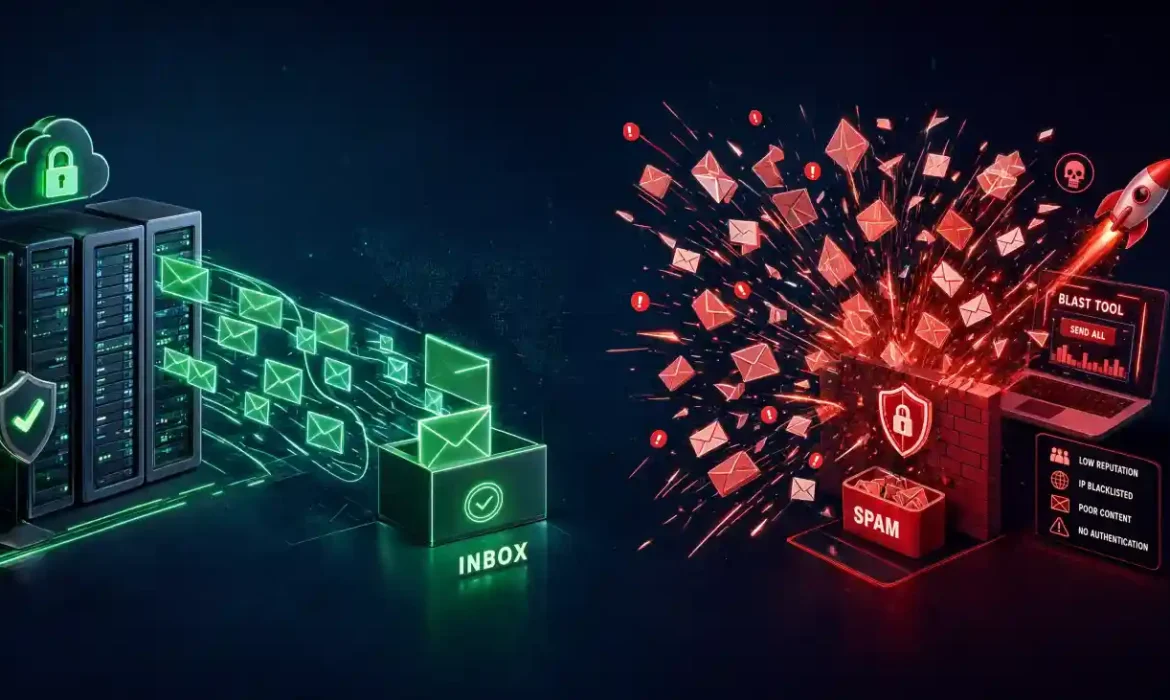
In-house sending infrastructure means an agency runs email campaigns through servers and domains it owns and manages directly, rather than routing them through shared third-party platforms. This matters for deliverability because sender reputation is shared across everyone using the same infrastructure -if other users on a third-party blast tool send spammy campaigns, your emails suffer the consequences even though you did nothing wrong.
This is one of the least understood parts of B2B email marketing, mostly because it’s invisible from the outside. Two agencies can run campaigns that look identical on the surface -same targeting, same copy, same volume -and get completely different results, purely because of what’s happening underneath.
Here’s what the difference looks like in practice.
What’s the Difference Between an ESP and In-House Infrastructure?
Most third-party tools fall into one of two categories: mass-market email service providers (ESPs) built for marketing newsletters, or blast platforms built for volume above all else. Both share sending infrastructure across thousands of customers.
That shared model works fine for permission-based newsletters, where recipients opted in and engagement is generally high. It works much worse for cold B2B outreach, where you’re sending to people who haven’t previously engaged with you. Cold outreach is inherently more fragile from a deliverability standpoint, and shared infrastructure adds risk on top of that fragility.
In-house infrastructure means the agency owns its sending domains, controls its own IP reputation, and manages authentication and warm-up on infrastructure that isn’t shared with unrelated third parties. Nobody else’s bad sending behavior can drag down your results, because nobody else is on the same infrastructure.
Why Do Agencies Protect Sender Reputation This Way?
Sender reputation is the single biggest factor in whether your email reaches an inbox or gets filtered out before anyone sees it. Inbox providers like Google and Microsoft track reputation at the domain and IP level, watching for spam complaints, bounce rates, and engagement patterns over time.
On shared infrastructure, that reputation is a shared resource. If one client on a blast platform is running an aggressive, unqualified campaign that generates spam complaints, the resulting reputation damage can affect deliverability for other clients on the same IP pool or sending domain -even ones running clean, well-targeted campaigns.
Agencies running in-house infrastructure avoid this entirely. Reputation is built and protected on domains used exclusively for your campaigns (or campaigns the agency directly controls), which means the outcome depends on how well your specific campaign is run, not on what strangers on the same platform happen to be doing.
This is also why in-house infrastructure allows for tighter control over throttling and volume. An agency managing its own servers can calibrate exactly how fast to ramp up a new domain and how much volume it can safely handle, rather than working within the generic limits a third-party platform applies to everyone.
What This Looks Like in an Actual Campaign
In practice, this shows up in a few concrete ways.
Calibrated sending domains. Campaigns run across domains chosen and warmed specifically for the volume and audience of that campaign, not a generic shared pool.
Throttled, consistent volume. Sending is paced deliberately -enough to hit campaign goals without triggering the sudden-volume-spike behavior that inbox providers flag as suspicious.
Suppression and list filtering before deployment. Lists are filtered to remove obvious mismatches and bounce risks before a campaign goes live, protecting the sending domain’s reputation from the start.
Direct visibility into deliverability data. Because the agency controls the sending infrastructure, it has direct access to inbox placement, bounce, and suppression data -not just the surface-level metrics a third-party dashboard chooses to expose.
The net effect: campaigns are more consistent over time, because the infrastructure isn’t subject to the unpredictable behavior of other, unrelated senders.
Frequently Asked Questions
Are third-party email tools always bad for B2B cold outreach?
Not always -for smaller volumes or warmer audiences, third-party tools can work fine. The risk increases with cold outreach volume, since shared infrastructure amplifies the impact of other users’ poor sending practices on your own deliverability.
How do I know if my agency uses in-house infrastructure or a third-party platform?
Ask directly. A good sign is if they can speak specifically about domain warming schedules, throttling limits, and IP reputation management for your campaigns. Vague answers about “using a trusted platform” usually mean shared, third-party infrastructure.
Does in-house infrastructure guarantee better deliverability?
It removes one major risk factor, but it’s not the only variable. List quality, authentication, and sending discipline all still matter. In-house infrastructure gives an agency more control over those factors -it doesn’t automatically fix a poorly managed campaign.
If deliverability control matters for your outreach, 24 Media Advert’s targeted email marketing services run entirely on in-house sending infrastructure, managed by ESP experts rather than shared third-party platforms. This post builds on our earlier look at why most B2B cold email lands in spam, where infrastructure was one of the root causes we flagged.